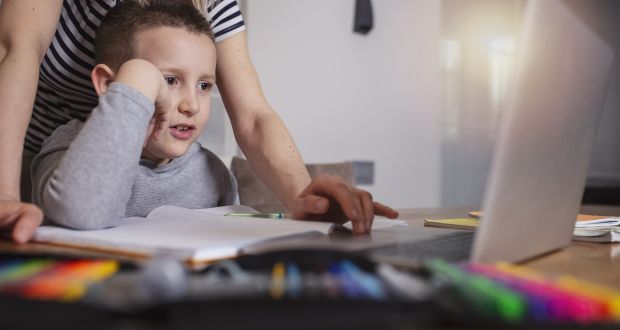
A study last summer found that one in 10 parents of primary
schoolchildren in Ireland lacked an appropriate digital device for home
schooling. Photograph: iStock
source: Irish Times, 9.2.2021
One of the things I least like
about Ireland is that it is hard to do a simple thing like giving some
money to charity without having very complicated feelings. Voluntary
efforts are a wonderful part of Irish society. But, far too often, they
are not a supplement to a properly functioning system of social decency,
but a substitute for it.
Last
week, I made a small donation to the Trinity Access Programme’s
nationwide effort to get laptops to second-level students whose families
can’t afford to buy them. Rather than making me feel good as a person,
it made me feel a bit sick as a citizen.
This
is not in any way a criticism of the campaign. It’s a great initiative
being run by terrific people. But what on earth is going on here? How
warped does a system of values have to be when the right to a basic
education is dependent on charity?
If
a government takes the decision to close schools and move classes
online, it takes on an absolute duty to ensure that every student is
able to access digital learning.
In
a lockdown, a laptop or tablet is as essential as a copybook and pencil
used to be. If you don’t have one because you can’t afford it, you are
being subjected to systematic discrimination.
Even
the Tory government in Britain understands this. It committed itself to
buying a million laptops or tablets for disadvantaged pupils. As of
January 24th, it had delivered 876,013 of them. There has been criticism
that this is not enough, but at least there is tangible recognition of
the state’s obligation.
Last
April, during the first lockdown of schools, the Government created a
fund of €10 million to allow schools to buy IT equipment – €7 million
for second level, €3 million for primary schools.
It’s a pittance. It represented a deliberate decision to leave thousands
of children and young people without the means to access education
online.
Poorest communities
In
October, The Irish Times interviewed the principal of Moyross National
School in one of the poorest communities in Ireland. He spoke of
fundraising for technology: “We purchased 60 digital devices, and it
nowhere near met the demand. We would need a further 60-80 at a
minimum.” So more than half of his pupils most at need did not have
proper access to digital learning.
In
August, by contrast, Simon Harris announced a fund of €168 million to
allow third-level institutions to buy digital equipment. The Government
went out and bought 16,700 laptops directly from Dell for distribution
to third-level students.
Spot
the difference. Universities are important. Their students are counted
as an economic asset. It matters that none of them is left without
access to classes.
Meanwhile,
a study last summer found that one in 10 parents of primary
schoolchildren in Ireland lacked an appropriate digital device for home
schooling.
The
Trinity programme mounted a huge effort during the first lockdown to
raise €300,000 and supply 1,000 reconditioned laptops or tablets to
disadvantaged school students in the Dublin area. It is now trying to
replicate that effort on a national scale and to supply 5,000 devices.
Even
without a discount for bulk purchase, the Government could buy 5,000
new laptops today for well under €2 million. We know it could deliver
four times that number because it already did that for college students.
Compare
this with the Government’s commitment of resources to the Stay and
Spend scheme introduced last October to stimulate the hospitality
sector. It proved to be useless – only €300,000 was actually claimed in
tax relief under the scheme before pubs, restaurants and hotels had to
shut again.
But the Government set aside €250 million for it. A fraction of that would solve the immediate problem.
Stamp of exclusion
This
could and should be done right now, today. Children and young people
who are already coping with disadvantage do not have time to waste.
Every day that goes by with a kid struggling to write an essay on a
phone and giving up in tears of frustration is a day on which this State
is putting a stamp of exclusion on that kid’s forehead.
So
where the hell is Norma Foley? What is Roderic O’Gorman, supposedly the
voice of children and young people at Cabinet, actually doing for those
experiencing this acute educational crisis? If Simon Harris can get
laptops to college students, why can’t they do the same for the pupils
to whom they have a moral and political responsibility?
As
well as being disgraceful in itself, the unwillingness to ensure that
every pupil has the basic tools needed to keep up with the rest of the
class points to a larger problem. It suggests a lack of thought in
Government about the social consequences of the pandemic.
Coronavirus
may not discriminate but our social system most certainly does. It is
our collective handling of it that is determining the shape of the
society that will emerge.
As
things stand, we are deciding by default to handicap even further those
who already face the highest obstacles. That is surely not what most
citizens want to see on the far side of this trial.