Showing posts with label climate change. Show all posts

Tuesday, 11 March 2025

Iron intake and iron status of Swedish adolescents with diets of varying climate impact

Contribution of mean total iron (and energy) intake per food group in girls (A) and boys (B) in the full sample of Riksmaten Adolescents. The underlying data are found in Online Resource Table S3

= = = = = = =

Hallström, E., Löfvenborg, J.E., Moreaus, L. et al. Iron intake and iron status of Swedish adolescents with diets of varying climate impact. Eur J Nutr 64, 93 (2025). https://doi.org/10.1007/s00394-024-03572-y

Abstract

Purpose

The risk of inadequate micronutrient intake is a concern of low-climate impact diets. This study analyzes the prevalence of iron deficiency (ID) among adolescents with varying dietary climate impact, with special reference to different types and dietary sources of iron.

Methods

Data on dietary intake (n = 3099) and plasma ferritin (n = 1030) were from Riksmaten Adolescents 2016–2017 survey of Swedish girls and boys aged 11–18 years. Dietary climate impact was estimated with life cycle assessment data. Linear and logistic regression models assessed associations between dietary climate impact, intakes of iron and food groups, and ID.

Results

Higher total iron and heme, but not non-heme, iron intake, was linearly associated with higher dietary climate impact. Compared to girls, boys had higher climate impact and low prevalence of ID. Girls in the highest climate impact quartile had 56% lower odds of ID (OR 0.44, 95% CI 0.24–0.81) compared to the lowest quartile, whereas no association was found in boys. Lower intake of red meat and heme iron was associated with ID in girls, while higher intake of dairy was associated with ID in boys. Menstruating girls and adolescents born outside of Sweden were identified risk groups for ID.

Conclusions

Girls with a more climate-friendly diet and lower intake of red meat/heme iron may be at higher risk of ID compared to girls with higher dietary climate impact. These results highlight the importance of considering risk groups of ID, such as menstruating girls, in the transition to more plant-based diets with lower climate impact.


= = = = = = =

This is an insightful article on the negative health impact that "environmentally friendly" diets have.

A must read!  

Monday, 24 April 2023

‘We must treat the Earth like a member of the family or a friend’

 source: Irish Times 


Ireland’s Children and Young People’s Assembly on Biodiversity Loss has called for greater respect for the rights of nature to be at the centre of Government decision-making.

Its final report issued on Saturday to coincide with Earth Day also calls for young people to be included in how Ireland responds to biodiversity loss, backed by stronger democratic standing for them and recognition of children’s rights.

The assembly met over two weekends in October 2022 at Glencree, Co Wicklow, and Killarney National Park, Co Kerry, seeking to ensure Ireland’s youngest citizens have their say in how Ireland responds to the challenge of biodiversity loss.

More than 500 people aged 7-17 applied to be part of the assembly, of which 35 were selected representing a diverse cross-section of society. Their report charts the journey participants went on over the course of their work together.

Monday, 14 November 2022

Jordan’s water supply strained by climate change and population rise

source: The Irish Times, 14.11.22

In one of the world’s driest countries, poorer residents are without household water for most of the week

Residents of Jordan, one of the driest countries in the world, have long been accustomed to a household water supply of only about 36 hours a week. But recently, even that meager flow has been curtailed by the debilitating combination of a warming planet and swelling demand.

Rajaa al-Bawabiji (64), like many others in the capital, Amman, plans her days accordingly. A human rights lawyer during the week, on Fridays she turns into a domestic marathoner, frantically cleaning, washing clothes and cooking three big meals during the brief window when the water flows.

But household taps ran dry this summer for as long as three weeks in parts of this small, dehydrated Middle Eastern nation. By early summer, when her taps did not spring to life on schedule, al-Bawabiji said she feared more outages were coming.

Everyone was anxious about water, she recalled. So she bought a second tank for her roof and chipped in with her neighbours to fill it with water purchased from a private water tanker business. “If you want to feel free, you need three tanks,” she said with a sigh.

Population growth, diminished water supplies and climate change have all taken their toll, while damaged and inefficient infrastructure and the considerable challenges posed by Jordan’s geography and topography have only made things worse. The resulting shortages serve as a warning of what the future might hold for the region and the world beyond it.

All of the country’s major water sources are near the borders, and water must be transported inland, an energy- intensive and increasingly expensive process as fuel prices rise. Rainfall has decreased precipitously in recent decades, and warmer temperatures mean that what rain does come evaporates rapidly. Longer and hotter summers have already shortened growing seasons for farmers.

“Climate change is really aggressively hitting Jordan in the last two years,” said Motasem Saidan, a former water minister and professor at the University of Jordan.

The country’s namesake river is nearly running dry. The flow in the Jordan River is less than 10 per cent of its historical average, and the Yarmouk River, a major tributary, is greatly diminished. The Jordan’s once-rushing waters feed into the Dead Sea, a saltwater lake that is disappearing.

The rivers are uneasily shared with neighbours: Israel and Syria upstream have diverted water for years for their own use. Increasing supply from these sources is challenging, particularly with Israel, which has had a chilly peace with Jordan for decades now.

Aquifers

All of this has led to an overreliance on extracting groundwater from aquifers below the Earth’s surface. The aquifers are being drained at roughly twice the rate at which they can be replenished naturally and now account for about 60 per cent of the country’s water supply.

Omar Salameh, a spokesperson for the Ministry of Water and Irrigation, said the government was well aware of the dangers of exhausting the groundwater supply. But as the population has grown — in no small part because of waves of refugees from Syria and other countries facing conflict — the government has come under pressure to meet soaring demand, he said.

The population is now estimated to exceed 11 million, up from 8 million just a decade ago, including more than 760,000 people registered with the United Nations as refugees.

“We don’t have other alternatives,” Salameh said.

For those with means, solutions and workarounds are available, at a price. But those without must simply go without. Many Jordanians turn to private water tankers. But the prices charged by those tankers, which are ubiquitous in wealthier neighbourhoods of Amman, rose to new heights this past summer. Buildings and homes keep water tanks on the roof, which are replenished by the government and rationed through the week. Wealthier households often have multiple tanks, which they can also fill with water purchased from the private trucks.

The vulnerable are hardest hit by the water shortages. The poor cannot afford to buy from private trucks and have less capacity to store water. All households have to buy their own tanks, and if one is damaged, the consequences are dire.

Ibtisam Yousef Abdelrahman, 55, a Palestinian who lives in the Wihdat refugee camp in southeast Amman, shares a two-room apartment with her husband, daughters and two grandchildren. They received a new tank from Unicef during the pandemic to replace a damaged, rusty steel one. But in mid-September, the Unicef tank broke, and the precious water gushed into the street.

“I started crying, running around the neighbourhood,” she said. “Now there’s no water, and I worry.”

Without the ability to save water for use throughout the week, she is back to going around to her neighbours with a bucket, imploring them to share. Her family is skipping showers and forgoing cleaning. She shrieks every time someone washes their hands, admonishing them not to waste a drop.

The average amount of water available each year to a resident of Jordan is well below the “absolute water scarcity” threshold of 500 cubic meters set by the United Nations. Salameh said it is about 80.

Desalination is a promising lifeline for Jordan, but it will not happen quickly. A large-scale desalination project in the port city of Aqaba on the Red Sea is in the works, but it will take years.

There is one potential quick fix: buying more water from Israel, a pioneer in desalination techniques. Cooperation on water was an important element of the 1994 peace treaty between the two countries, and they signed a water-for-energy agreement at the UN climate conference in the Egyptian Red Sea resort of Sharm el-Sheikh on Tuesday.

Protests broke out in Amman last year when the plan, which was brokered by the United Arab Emirates and would involve Jordan sending solar energy to Israel in exchange for water, was first announced. An overreliance on Israeli water is unpalatable to many Jordanians, who oppose the occupation of the Palestinian territories.

Potentially destabilising

But water is a critical national security issue in Jordan, and shortages threaten to destabilise a stalwart US Arab ally that has been an oasis of calm in a turbulent neighbourhood. Iyad Dahiyat, a former water ministry official, said the water portfolio is as important as the military given the threats to Jordan posed by climate change.One recent study predicted that severe and potentially destabilising water shortages will become common in Jordan by 2100 unless the country makes significant changes.

“The government needs to increase supply to communities to limit discontent,” said Sandra Ruckstuhl, an American researcher based in Amman and a senior adviser at the International Water Management.

Ruckstuhl and other experts say the government needs to raise water prices based on household income to account for the soaring cost of delivering it to homes and businesses. But many Jordanians are already struggling with unemployment and high prices, and that would be an added, and unpopular, burden.

Choosing crops wisely and managing water are crucial for Jordanian agriculture as climate change accelerates. The sector once used about 70 per cent of the country’s water supply, though it contributes relatively little to the gross domestic product.

Use has decreased to around 50 per cent, which Salameh cited as a promising indicator. But many farmers still focus on water-intensive crops that are becoming more difficult to grow.

Khaireddin Shukri, 68, is a retired farm owner and a consultant who has long pushed for crops that require less water and bring in more money. He said the water issue revolves around planning and pointed to inefficient practices and waste.

“It’s a country with huge potential but lack of management,” he said of Jordan.

On a visit to a date farm that Shukri helps oversee, he showed off the crop that he has championed for years: Medjool dates, which can tolerate salty, lower-quality water, and garner high prices.

Yields at farms in the area were small this summer because the fields received less water and what did come was saltier than usual. At one farm, they grew only half of the more water-intensive crops like eggplants, tomatoes and peppers that they sell to international supermarket chain Carrefour, Shukri said.

At an olive farm, his team faced an unusual case of water theft during a heat wave, and by the time they restored the water supply, they had lost the whole crop. “You lose a crop, you lose a year of your life” Shukri said, shaking his head. – The New York Times

Good ways to save money while saving the planet

source: Irish Times 14.11.22

With Cop27 continuing, the world is still talking very seriously about the environment and what we have done to it, and what our relentless drive for more growth and more stuff might mean for people everywhere in the years ahead.

As you will no doubt be aware, the news from Egypt could scarcely be bleaker, with UN secretary general António Guterres telling world leaders that humanity is on a “highway to climate hell with our foot on the accelerator”.

The financial cost of climate change was also laid bare at the global summit last week when it emerged that poor countries would need $2 trillion (€1.98 trillion) a year in funding by 2030 just to cope with climate breakdown.

The money will have to be spent to help climate-vulnerable states to switch away from fossil fuels, invest in renewable energy and other low-carbon technology, and cope with the effects of extreme weather.

With talk of trillions of dollars and the failure of countries – including this one – to take the crisis as seriously as it should be taken, it would be easy to surrender to the negativity. But while much of the narrative that swirls around climate change is how much it is going to cost, both on a global and on a personal level, that is by no means the full picture, and there are many ways being environmentally friendly will actually save you money while simultaneously reducing your carbon footprint.

Here are just 10 ways you can make a difference and cut your spending too.

1

Drive less

Too many of us – including Pricewatch – rely too much on our cars to cover even small distances. And that reliance is having a terrible impact on the planet and our wallets.

Road transport accounts for about a fifth of carbon-dioxide emissions across the EU, with passenger cars making up 61 per cent of the emissions from road transport. So a concerted effort to drive less would have a significant impact on the level of pollution we produce. How much? Well, every kilometre you choose not to drive when you otherwise might have will save about 250g of CO2 emissions. That means if you use your car just one day less each week than in the past you will see your CO2 emissions fall by tens of thousands of kilogrammes every year.

The move will also save you hundreds of euro each year. The average motorist drives 16,000km every year, and if the average price of a litre of diesel right now is €2.02 – as the AA tells us – then driving the average family car, which does 12.4km per litre (35 miles per gallon), will cost about €2,606 annually. If you were to reduce your fuel bill by just 20 per cent you would save more than €500 over the course of the next 12 months.

Drive smarter

It is not all about how much you drive; how you drive matters too. If you could cut the amount of fuel you use by even 5 cent by being a bit more canny about how you use your car, then you would reduce your carbon footprint and save yourself another €120 or so each year. So do not over-rev your engine, drive in the right gear, and at a slightly slower speed on a motorway. Keep your boot empty, your tyres at the right pressure, get your car serviced, remove any roof boxes or racks that cause a drag on your car and only use the heat or air conditioning if you absolutely have to.

Get on your bike

The humble bicycle is one of the best ways of lessening your personal pollution levels while improving the quality of your life and saving you money into the bargain. By taking advantage of the tax breaks available to cyclists and their employers, you can get a decent bike for a knock-down price. The Bike to Work scheme covers bicycles and accessories up to a maximum of €1,250, rising to €1,500 for an electric bike. Your employer buys it and you pay for it, tax-free, over 12 months, which effectively knocks about 40 per cent off the price. If your commute is just 8km each way and you usually drive, then you will save about €600 a year in fuel costs alone each year. That is less than the bike and gear will cost you, which means you will be better off just 10 months after you buy your bike. And you will keep saving money after that.

Keep your house in order

If your attic was insulated decades ago, you might want to have it redone and take advantage of SEAI grants to do it. Those grants could be worth 80 per cent of the total cost – or €800. And getting a decent job done in the weeks ahead could see your energy costs fall by €120 over the course of a year while simultaneously reducing your CO2 emissions. Don’t forget to police the heating and lighting of your home while washing your clothes on an eco setting, reducing your reliance on your tumble dryer and immersion and ensuring your boiler is serviced. All of that could lessen your domestic carbon footprint by 10 per cent and save you €400 into the bargain.

Eat less meat

Not a universally popular notion in this country, but it is one worth considering. Serious climate activists will suggest that you eat no meat and consume no dairy products on the basis that it is one of the biggest drivers of global warming. But Irish people love their meat products, which is why we consume twice the global average of meat. But 25 per cent of the average Irish person’s carbon emissions comes from diet and, by becoming a vegetarian, a person can dramatically reduce one’s emissions. But only about 5 per cent of Irish people follow a vegetarian diet, with the number of vegans much lower again. We are not going to suggest that the 95 per cent who do eat meat should cut it out immediately, but if we were all to reduce the amount of it we consume, it would be better for the environment, better for our health and better for our wallets, particularly at a time when meat and dairy prices are climbing at as much as three times the rate of general inflation. Let’s say you spend €20 a week on steak and mince for two dinners and you replace that with €5 worth of beans, vegetables or pulses, you will save yourself €750 over the course of a year and you probably won’t notice a huge difference in the quality of your life, while the quality of your diet might actually improve.

Tackle your food waste

The food we throw away is another big problem when it comes to both the planet and our pockets. We bin more than a million tonnes of food every year. That hurts the environment on multiple levels. The waste produces toxic methane in landfill, for one. But it also has to be transported from the home, the farm, the shop or the restaurant to that rubbish tip. And then, of course, there is the huge impact the production of the food we do not eat has on the environment.

By far the most environmentally friendly way to cut your emissions in this area is to eat what you buy, and don’t buy more than you need. If a typical Irish grocery bill is about €8,000 per year and you are absolutely ruthless about reducing waste, you could see that bill fall by at least €1,000. So, make a meal plan and a list and base the list on what you already have in your presses, your fridge and your freezer. Stick to the list. Don’t be suckered into buying stuff you don’t need by the promise of special offers. Make more effective use of your freezer. If you are not going to use a full sliced pan before the bread turns mouldy, put a few slices in a freezer bag. Don’t pile food on to plates – serve it in communal bowls. That way people can eat what they want and what is left in those bowls is more likely to be reused.

Stay local

Rather than driving to a faraway place to do a big shop, consider what alternatives are in your neighbourhood and then buy what you need from your local butcher, baker or vegetable shop. Where possible, shop in farmers’ markets and co-ops and buy food that is grown locally. And if your wallet allows it, buy more organic products – they are better for the environment and, possibly, better for you too.Reduce, reuse, recycle This is a much-used phrase but, while you might be tired of hearing it, adhering to it will save you money and reduce your carbon footprint. In essence, we need to consume less and use it for longer and in more ways than it was intended. And then, once we are done with it, try to find another home for it. So, maybe think twice before buying. Do you really need it? Will it really last? And if you can afford it (and we know that not everyone can), buying better by buying less is a mantra to live by.Look at your clothes The production of textiles is the fourth-largest cause of environmental pressure after food, housing and transport, according to the European Environment Agency, while the United Nations has described the industry as the second-worst polluter on the planet, behind oil. The textile sector generates about 10 per cent of the world’s greenhouse gas emissions, pumping at least 1.2 billion tonnes of CO2 into the atmosphere every year.

That makes fashion worse for the environment than air travel and shipping combined. The industry also uses more water than a country the size of Ireland and pollutes rivers with dyes and toxic chemicals. Globally, close to 100 million tonnes of textile waste is created every year, which works out at about one rubbish truck full of clothes heading into landfill every single second. Try to be part of the solution by shopping smarter when it comes to clothes.

Only ever buy what you need and try to find alternative sources when shopping. By buying clothes second-hand, for instance, you can acquire new stuff – if you need it – without contributing to the climate crisis and, depending on where you choose to shop, you can also support worthy causes when you spend. And such an approach will definitely save you money. Second-hand thriftiness is also very on-trend.

Don’t confine yourself to local charity shops either. DoneDeal and eBay are great for finding specific items, while Thriftify.ie is a rather brilliant way to shop across hundreds of charity shops without leaving your couch. And then there is the notion of a black bin party. And what is that? It’s a fun way to get new clothes and hang out with your mates. Get everyone to put all the clothes that they no longer have any use for into a bin bag. Everyone brings their bags to someone’s house. Open wine, dump everything on the floor and then rummage around for things you might like. Bring whatever is left behind to a charity shop.

And some other measures

Only drink tap water. Plant more house plants. They will do their bit to suck some of the carbon out of the atmosphere. If you are not overly green-fingered, pick easy-to-grow things such as bamboo – it is a nice house plant, grows quickly, is low-maintenance and can suck as much as four times the amount of carbon dioxide from the air as other plants. Use keep cups – many decent coffee shops will give you a discount if you do. Work from home. It will save you money on commuting costs. Use soap rather than shower gel.Take all these steps and we reckon you could handily save yourself a couple of grand. And feel better about yourself into the bargain.

Thursday, 21 July 2022

The Irish Times view on agricultural emissions: farmers must play their part


The Irish Times view on agricultural emissions: farmers must play their part

[The Irish Times, Editorial, 21/7/2022]

= = =

and our view: the current situation we need to accept is that the impact of climate change on our lives is more severe than micro-management political games between different ministries. All sectors contributing to GHGs (Green House Gases) emissions must raise their game and meet the challenges ahead. It is not easy! It needs political engagement and honest scientific dialogue; two features that we are failing again and again. But, if we want to be able to say to our children that we did all we could in order to slow down the climate change, we need to act in a coordinated way and we need to act now! Tomorrow is too late...

Ioannis Zabetakis


Tuesday, 9 November 2021

Young change-makers: New leaders needed to really tackle climate crisis


If one teenager in Sweden could inspire a global movement to strike and march, surely teenagers could do more than just draw attention to this issue. Maybe they could help solve it?


source: the Irish Times, 9.11.2021 ; by Peter McGarry

Peter McGarry is founder of The Earth Foundation. Learn more here 

==============================================

Half way from coal, half way to diamond. That’s how I would describe the current state of the climate change debate.

I don’t doubt the sincerity of the leaders gathered in Glasgow for the Cop26 event. Yet despite scientific and political consensus that calamity is certain without action, the vast majority are beholden to electoral cycles and thus incentivised to make promises tied to goals in the distant future.

I believe this approach will fail, and by the end of this decade we will have to look to a new generation of leaders with a more forceful and urgent approach. My strong conviction is that the leaders who will solve this issue are sitting in classrooms around the world today.

Peter McGarry is founder of The Earth Foundation. Learn more here theearthprize.org/trailer

Reading entries of the recent Irish Times children’s climate writing competition strengthened my belief that these children will have to grasp the nettle in coming years when the current crop of leaders are shown to have lacked sufficient courage and urgency to address the task at hand.

But we need more than writing competitions to prepare this generation for the tough decisions they will have to make. We need global movements to educate, inspire, mentor and empower these young future leaders.

I happen to be part of one such movement, with teenage students in 76 countries and counting, competing to find the best environmental sustainability solutions.

I believe this is how future leaders will be forged with a solution-based mindset amid the background noise of lofty goals lacking clear delivery plans and enforcement mechanisms streaming from Glasgow.


Street cacophony

Let me take a moment to explain how my journey started on this path, and the movement called The Earth Prize came about. Normally fate doesn’t come knocking at the window. In my case, it wasn’t so much a knocking sound as a cacophony of noise. Sitting in an office in Geneva, you don’t expect to be drawn to stare outside to see what the commotion is.

I was dumbfounded to see hundreds then thousands of kids marching by on the street below. The march was one of numerous school strikes across the globe inspired by Greta Thunberg, the teenage Swedish environmental activist.

That was September 2019, and the experience gnawed away at me until one day during the Covid lockdown of early 2020 when I decided to do something about it.

My thoughts over that interval were on how best to harness and leverage the frustration and passion seen in those teenagers. If one teenager in Sweden could inspire a global movement to strike and march, surely teenagers could do more than just draw attention to this issue. Maybe they could help solve it?

Suddenly it made sense why the school strikes had gone viral; students were frustrated and understandably so

That’s when I decided to set up a global competition for teenage students to find fresh ideas and solutions to environmental problems. Conversations with teachers and students emphasised the frustrations many had with the lack of sustainability on the syllabus.

Suddenly it made sense why the school strikes had gone viral; students were frustrated and understandably so. I decided we needed to educate them on the key sustainability concepts.

Young change-makers

Ideas need a spark, so my team and I decided we also had to inspire. We looked around the globe for young change-makers, people and organisations who were solving environmental problems today in the real world.

We found many amazing change-makers, and are showcasing them on our learning platform so students can learn from their journeys, and the obstacles they had to overcome.

Education and inspiration can create a foundation and a spark, but teenagers also need to be mentored. Students from top universities across the world were interviewed and a pool of 30 were selected.

These passionate mentors are volunteering to help every teacher and student in the competition by sharing their knowledge and experience. It was incredibly gratifying to see a mentor answer the first question from a teacher in Nigeria. a global community had sprung into action.

Students from top universities across the world were interviewed and a pool of 30 were selected

Since registration for The Earth Prize opened on September 1st last, teams from schools in over 76 countries have signed up to compete. From Afghanistan to Zimbabwe, from schools in Middle East refugee camps to my own alma mater, Naas CBS in Co Kildare.

Tomorrow’s leaders, who will have to make the tough decisions we are currently shirking, need to go beyond marching and writing essays. They need to start forming a solution-focused mindset.

They need to prepare for their roles as leaders who will solve the climate crisis. I hope many more Irish schools and teenage students will join our movement.

Saturday, 6 November 2021

Fintan O’Toole: If only we could fight climate change like we fight wars


The question that now faces the world is a stark one: can humans concentrate their collective minds without an external enemy? Photograph: Getty

--------------------

Fintal O'Toole, Irish Times, 6th November 2021

-------------------------------------------------------------------------

"Depend upon it, sir,” said Samuel Johnson, “when a man knows he is to be hanged in a fortnight, it concentrates his mind wonderfully”. We do indeed have to depend upon the Cop26 summit proving Johnson right, and that the threat of extinction will concentrate the collective mind. 

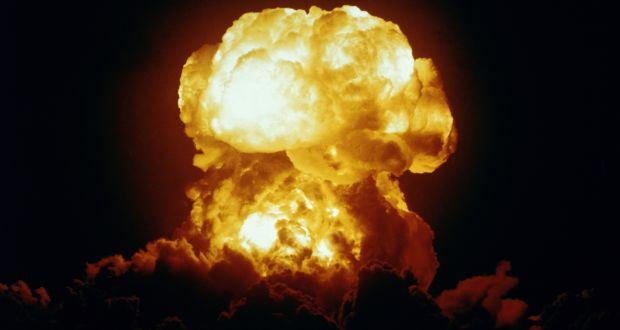
There are, at least, some precedents. One of them is, ironically, the origin of the great fear that has now been displaced by climate change: nuclear war.

Over Christmas in 1938, two physicists, Lise Meitner and her nephew Otto Frisch, had a startling insight. They realised that if you bombarded a uranium nucleus with a neutron, it could split into two, releasing a great amount of energy.

It very quickly dawned on scientists that this could become a chain reaction, producing more and more energy. That process could, in theory, be harnessed to make a bomb of unprecedented destructiveness.

In the spring of 1940, Frisch and Rudolf Peierls, having, like Meitner, fled from the Nazis, arrived in Birmingham. There they figured out something even more alarming – a lump of uranium-235 the size of a golf ball would be enough to make such a bomb.

An even darker thought followed – if they had worked this out, then surely the brilliant colleagues they had left behind in Germany must have done the same. Hitler might well be working on an atomic bomb.

This was, as Jewish people already knew, an existential threat. If Hitler had the bomb and his enemies did not, he would certainly use it. “As a weapon,” Frisch and Peierls warned Winston Churchill, “the super-bomb would be practically irresistible”. They argued the imperative of developing an atomic bomb as a “counter-threat”.

Extraordinary

What happened next was an extraordinary concentration of the mind. Churchill, who himself had already foreseen the possibility that the splitting of the atom could lead to a new and fearful kind of weaponry, alerted US president Franklin D Roosevelt.

Out of this dread came a staggering achievement. The Manhattan Project really got under way in September 1942. The first atomic bomb was exploded less than three years later, in July 1945.

The horrors of Hiroshima and Nagasaki make it hard to celebrate this achievement. But it was, in itself, stunning.

Creating the atomic bomb was actually much more difficult than the scientists had imagined. It required an unprecedented concentration of industrial might, scientific brilliance, governmental commitment and vast public resources.

The reason all of this came together was existential dread: terror of the Nazis and what they would do if they got the bomb first. The prospect of being hanged in a fortnight made what was scarcely possible an achievable reality.

The great irony, of course, is that this remarkable accomplishment in fact added to the common store of dread. Nuclear weapons, initially a guarantor against extinction, became themselves the bearers of the threat that humanity might obliterate itself.

I sometimes wonder whether one of the deep-lying reasons for the failure of governments and societies to acknowledge the peril of climate change was a kind of dread fatigue.

Everyone who lived through the cold war also lived with a burden of anxiety: the knowledge that an apocalyptic conflagration would trigger the nuclear winter in which most life on Earth would perish. It was a constant background noise that, at moments of crisis, came to the fore and became overwhelming.

It was perhaps unfortunate that the first report of the Intergovernmental Panel on Climate Change was published in 1990, just after the fall of the Berlin Wall. One burden of terror was being lifted, but here was another coming along right on cue to take its place.


Existential anxiety

Perhaps it was natural to think: give us a break. Perhaps humankind needed a holiday from existential anxiety. But the effusion of greenhouse gases did not take a vacation – it just kept going.

Maybe there has also been a paradoxical hangover from the cold war – the worst did not happen. The hard rain did not fall. The eve of destruction was not followed by the dark night of annihilation. 

Maybe the period between 1989 and the Paris Agreement of 2015 can be seen as humanity’s long exhale, a sigh of relief that the great danger had apparently passed and we were safe now.

There was a deep desire not to know this was the ultimate false sense of security. It was a pleasant illusion to imagine that, since we got away with the game of chance that was mutually assured destruction, we would get away with every other form of dicing with death.

Indulgence in that illusion has led us to the present crisis. The question that now faces the world is a stark one: can humans concentrate their collective minds without an external enemy?

The great fusions of politics, technology, industry and science – like the Manhattan Project and the Apollo moonshot – have been driven by warlike competition.

Without the fear of the Nazis, the atom bomb would not have been developed at such dizzying speed. Without the space race between the Americans and the Soviets, there would have been no man on the moon.

A pessimist might say that this is precisely the problem with climate change. There is no Them, only an Us. We are our own worst enemy, and we have to be our own bogeyman. We have to scare ourselves into action. 

It is war that has typically speeded up history by galvanisng the idea of a threat that must be countered, whatever the cost. It is competition for dominance that has spurred governments to undertake the seemingly impossible.

But now we face a threat that cannot be countered by competition between nations. It can be met only by co-operation on a truly global scale. Survival demands that we be afraid, not of each other, but for each other, and for all the others not yet born.

What we know, however, is that the concentration of the mind produces amazing results. If political systems really want to, they can harness science, technology, government, economics and industry to the same wagon. And then things can move with extraordinary rapidity.

Can that willpower be generated without war?  

More than a century ago, George Bernard Shaw, in Man and Superman, had the Devil suggest that “in the arts of life, man invents nothing, but in the arts of death, he outdoes nature herself”. But we can no longer outdo, or outrun, nature. 

If half the money, ingenuity and energy that has been devoted to the arts of death is channelled into the rapid decarbonisation of the global economy, it will be achieved.

The gallows we have built for ourselves does not have to be ascended. We have the power, seldom granted to those who have committed capital crimes against nature, to grant ourselves a reprieve.


Wednesday, 28 April 2021

Alternative food strategy sets out how to cut agricultural emissions

 Source: Irish Times


Ireland’s proposed 2030 agri-food strategy is out of line with the Government’s economy-wide emissions reduction targets for the next decade, according to a report by 70 environmental and climate groups.

They warn that, if adopted, the strategy would force impossible cuts on other sectors.

Having left the “industry-dominated” group drawing up the strategy – published in draft form by the Minister for Agriculture last week – the Environmental Pillar (EP), Stop Climate Chaos (SCC) and Sustainable Water Network (Swan) have published an alternative report which sets out how to “drive down agriculture emissions while simultaneously restoring our depleted biodiversity and water bodies”.

Their report puts the Green Party in a difficult position, given its support base, as the party has backed the strategy, which is open for public consultation.

The agri-food strategy, which was criticised by the groups as “entirely inadequate from a climate and environmental perspective”, is broadly aligned with the Climate Bill.

Sunday, 28 March 2021

Greenouse gases, methane and the ...cows


Will Ireland sacrifice its sacred cows to meet climate change targets?

‘No country has ever set such an ambitious target,” said Green Party leader Eamon Ryan, when describing the short-term goal of halving emissions by the end of this decade at the launch of the Climate Action and Low Carbon Development (Amendment) Bill 2021 last week. The bill’s long-term goal is no less ambitious. By 2050, it wants Ireland to reach net-zero emissions — producing no more CO2 than is removed from the atmosphere through sequestration measures such as planting trees. This is also “a challenge beyond compare”, Ryan said.

Micheál Martin, the taoiseach, argued that the “hardwiring into law” of sectoral emissions targets, which means that the government could be taken to court if it failed to meet them, would fundamentally alter Ireland’s response to the climate crisis by “forcing change”.

(...)

The big political sticking point when it comes to reducing emissions in Ireland has been agriculture. It accounts for 35 per cent of emissions, more than any other sector. Farmers have long argued that they are a special case, on the basis that it is harder for them to reduce emissions than it is for other sectors, and that any reduction in beef or dairy production here will simply be displaced to other countries, probably in South America, which may be less environmentally responsible.


= = = 

Let’s discuss Joseph Poore and Nemecek’s study as it is regularly referenced.

Let’s review some of these issues...

•Animal agriculture unfairly gets corn and soy agricultural GHGs added to their LCAs. Corn and soy are grown for human use first. We’re LUCKY that cows will turn our waste into nutrient dense foods.

•The study doesn’t take into account water footprint. 

•And then, for emissions, the gases lifecycle isn’t taken into account.

Another glaring issue is that the study is based on conventionalagriculture. No mention of regenerative agriculture, holistic planned grazing, or agroforestry. 

In the end, “sustainability” will depend on what variable you are optimizing—is it greenhouse gas? Land use? Acidification? Animal welfare? Productivity? They don’t always point in the same direction.

Let’s go over the bullet points in more detail.

Feed:
Cattle feed on 90-100% grass/ alfalfa/ hay. The grain they do consume is by-product after human use (for instance high fructose corn syrup, ethanol, corn meal etc and soy oil). Whole grain can be expensive to feed. They do get whole grains though especially during finishing which is usually grains that were deemed unfit for human consumption. Then there is also silage which is the whole plant all chopped up.

Water Footprint:
First of all not all water is equal. 

So really it isn’t about total water but what kind of water.

The water that pastured animals get is almost entirely green water. It falls as rain. It’s not blue water that is pumped to them. All animals can be pastured. 

* One main difference among all methods for assessing water use is whether and how they include green and gray water. The “water footprint” approach includes green water, whereas life cycle assessment approaches tend to exclude green water or to include only the variation in green water resulting from changes in land use. A second difference is whether water use is reported as a volume of water or as an index of water-use impact (e.g., H2O equivalents). A third is whether water that returns to the same location (e.g., in urine) is considered to have been consumed.


* Because of these differences and the fact that existing studies have analyzed only a limited number of different livestock production systems, methods give wildly different results for the same livestock product. For example, estimations of water use to produce 1 kg of beef range from 3 to 540 L of H2O or H2O equivalents for the life cycle assessment approach and from 10,000 to 200,000 L of H2O for the water footprint.

GHGs and their lifecycle.

First of all the largest AGRICULTURAL contributor to GHG emissions is PLOWING, not cattle.

"We can't eat our way out of climate change...U.S. beef has one of the lowest carbon footprints in the world, 10 to 50 times lower than some nations. Greenhouse gas emissions (GHG) from cattle only account for 2-3% of U.S. GHG emissions. For comparison, landfills contribute 2.2%; 27% comes from transportation; 27% from electricity; and 40.9% from other sources."

One of the biggest concepts being missed in our push to reduce “emissions” is that cattle are actually part of the carbon cycle, while extracting fossil fuels are introducing NEW greenhouse gasses to the environment.

Methane:
There is an old fake-science idea doing the rounds again at the moment. This is that cows are culprits in the global warming narrative. The problem, however, is that the scary image of cows destroying the planet with their carbon emissions doesn’t fit with how the planet actually works.

No cow alive today, nor any cow that has ever existed, nor any cow that will ever exist, can add a single atom of carbon to the atmosphere that wasn’t already there in the first place.

At one point of the carbon cycle, it is true that cows emit carbon dioxide (CO2) and methane (CH4) to the atmosphere, each of which contains one atom of carbon. This is a basic fact of biology – but what about some other basic facts to go with it?

It would seem the fact that ruminants emit carbon gases is regarded as the clincher argument by people like Rosemary Stanton and Kris Barnden, who recently published an article on the ABC News website damning cattle. The problem is they fail to put this isolated fact together with others to give it context and, in this way, create a misleading impression. They fail to describe how a cow exists within the carbon cycle. They fail to ask a fundamental question; ‘Is the carbon a cow emits new carbon to the atmosphere?’

The believer/activists don’t explain that cows eat plants and that all the carbon in a plant comes from the atmosphere, not the ground. The carbon in the leaves comes from the minute traces of carbon dioxide in the air around them via the process of photosynthesis. Even the carbon in the roots of plants comes from the atmosphere and even the carbon in the carbohydrate sugars that the roots exude to soil microbes in a swap for nutrients, comes from the air above us. The energy for this is captured by the plant’s own solar panels – its leaves.

The believer/activists don’t explain that when a cow eats a plant it is vicariously ‘eating’ carbon from the atmosphere. They don’t explain that, when that cow exhales carbon dioxide or belches methane, the carbon in those gases goes back to where it ultimately came from – the air around them.

The implications of photosynthesis are not divulged to the public by the cows-are-culprits believer/activists. They don’t explain where animals get their energy from and how their food sources become laden with energy. (Hint: it’s ultimately from the Sun and it involves the carbon cycle, the water cycle and photosynthesis.)

Plants combine carbon, hydrogen and oxygen to make carbohydrate chains or ‘sugars’. (C6H12O6)

Cows and other animals consume these carbohydrate sugars and ‘burn’ them as energy to run their bodies. As a result of this ‘combustion’ the by-product of carbon dioxide is produced and exhaled to the atmosphere. We humans do the same thing. Once in the atmosphere, the carbon dioxide again becomes available for photosynthesis in plants, and so the cycle starts over again. This is an example of sustainability in plants and animals.

So, with regard to the carbon dioxide the cow breathes out, it goes straight back to where it came from – the atmosphere.

What about the methane?

The methane issue is a kind of blind spot for those who vilify cows because most bovine critics would see themselves as deeply concerned about preserving a natural and organic environment. Well, methane from cattle is a natural and organic gas but the detractors portray it as something else – something unusual, something particularly sinister. Methane production is also solar powered – another appealing feature to those concerned about natural and organic things. Methane inevitably results from the process of plant growth (photosynthesis) and subsequent fermentation by various agencies such as microbes, insects and ruminant animals. Methane occurs naturally and abundantly in rainforests, wetlands, lakes, swamps, rivers and arid zones.

Methane is produced naturally and organically in the environment by microbes, ruminant animals, wild grazing herds and the prodigious activity of insects such as ants and termites.

A cow has a part of its digestive process that we do not have and this enables it to eat tough cellulose food. This fermentation chamber is called a rumen where, with the aid of microbes, the cow processes tough cellulose foods in the absence of oxygen. The by-product of this combustion is methane (CH4) which is then belched.

The methane molecule is oxidized within one decade and brakes down into CO2 and water. – see equation at end. For the period that the methane molecule is in the atmosphere it is a potential global warming gas but its molecular characteristics – its heat absorption capacity – is not well matched to the frequency at which the Earth radiates heat. For this reason the theoretical heat-trapping potential of methane is curtailed when the gas converts to its original form. And, in any case, it is a natural part of the environment that has been happening for hundreds of millions of years by vast herds of ruminant herbivores across the globe.

It seems that the detractors of cattle are reluctant to concede that the emissions of cows are part of a closed and self-completing carbon cycle in the atmosphere. This organic cycle involves all plants and animals, including ourselves.

In conclusion, the carbon gas emissions of cows are just one point in a giant circle that is the atmospheric carbon cycle. If you plot the other points in the cycle, it forms a giant circle which loops back to the start point. There is no new carbon in the atmosphere as a result of a cow’s existence.

Some relevant equations

Photosynthesis.

The general equation for photosynthesis is:
6CO2 + 6H2O + Sunlight absorbed = C6H12O6 + 6O2

Note: The C6H12O6 molecule is a carbohydrate molecule – a food ‘sugar’ which can be eaten by an animal and ‘burnt’ to produce energy. When this molecule is ‘burnt’ it produces carbon dioxide (CO2) as a by-product. This is then exhaled to the atmosphere as the same gas as it was prior to the growth of the plant the cow eventually eats.

The Breakdown of methane.

Conversion of methane to carbon dioxide and water is:
CH4 + 2O2 = CO2+ 2H2O + Energy (Heat given off)

Also, when methane is measured from cows, it's done via "gas chambers" or enclosed systems where only the methane that the bovine burps out is measured. It's often never measured in an ecological context, where methanotrophic bacteria are available at the soil surface to oxidize the methane that the ruminants burp out. 

While this is explained pretty well for the layman, another thing that wasn't mentioned was the role of hydroxyl radicals (OH compounds) that also act to oxidize methane. Hydroxyl radical comes from when oxygen reacts to UV light and frees up an oxygen atom; that oxygen atom binds with a hydrogen atom that came from water vapour creating the OH radical, which binds to CH4 to oxidize it, rendering it unstable. These hydroxyls often come from the water vapour put off by transpiration of plants. And of course, the greater the green cover there is (the greater number of green photosynthetic solar panels there are), the more water vapour and oxygen is given off, the greater the efficacy of these natural atmospheric compounds have to oxidize methane. 


Friday, 26 March 2021

news review on climate bill developments


What happens next on Climate Bill in build-up to Ireland’s first carbon budget?

Government has approved the appointment of three new members to the Climate Change Advisory Council

Thursday, 18 March 2021

How much of global greenhouse gas emissions come from food?


 source: How much of global greenhouse gas emissions come from food?

Summary

There are a wide range of estimates for how much of the world’s total greenhouse gas emissions come from food. Some studies say this figure is one-quarter, some say it’s more than one-third.

Where do these differences come from? There are three reasons why some of these estimates vary so much:
1) some studies do not include emissions from cooking and food waste;
2) different studies disagree about the emissions from land use change and deforestation; 
3) some, but not all, studies include non-food agricultural products such as cotton, wool, leather and biofuels

The specific number that answers this question depends on these three factors, but the range of possible answers is not too large: around 25% to 30% of global emissions come from our food systems, and this rises to around one-third when we include all agricultural products.


One-quarter or one-third: how much of global emissions come from food?

It is nothing new that estimates of food emissions span a wide spectrum. The Intergovernmental Panel on Climate Change (IPCC) Special Report on Climate Change and Land reports a range from 10.8 and 19.1 billion tonnes of CO2-equivalent (CO2e) emissions per year. That’s between 21% to 37% of global total emissions. Quite a big difference. We’ll soon see where these disagreements come from.

In light of this, the difference in estimates from Poore and Nemecek (2018) of one-quarter, and Crippa et al. (2021) of one-third are not that surprising. They fall right in the middle of this wide range. Given that they are using very different  methods to get to these numbers it is actually encouraging, from a research perspective, that these estimates are so close to each other. But we should still try to figure out where the differences come from.

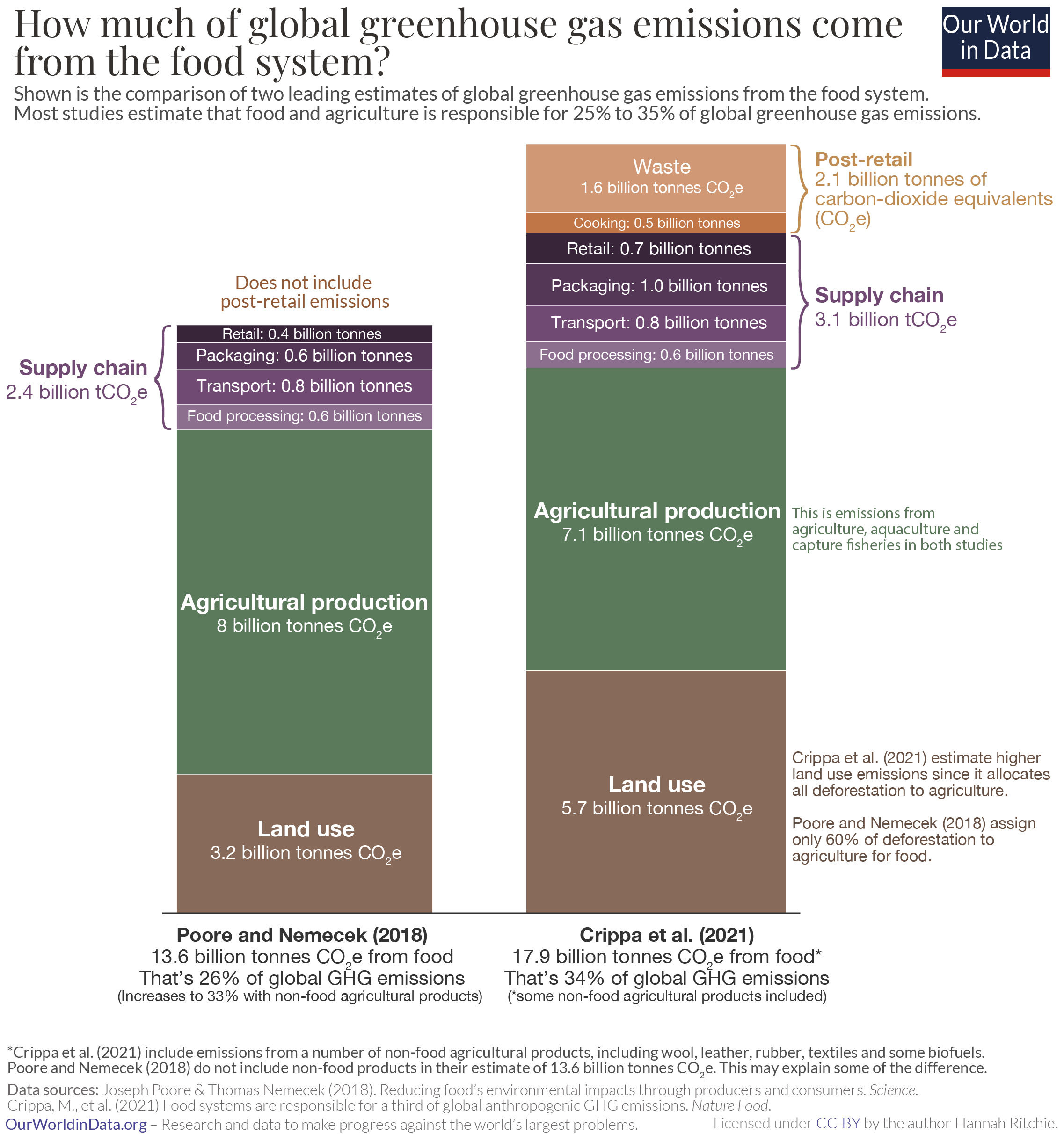
In the chart here I’ve shown the results of these two studies side-by-side. I’ve grouped emissions into their comparable parts of the food chain:

  • Land use: this includes deforestation, peatland degradation and fires, and emissions from cultivated soils.
  • Agricultural production: this includes emissions from synthetic fertilizers (and the energy used to manufacture them); manure; methane emissions from livestock and rice; aquaculture; and fuel use from on-farm machinery.
  • Supply chain: this includes all emissions from food processing, packaging, transport, and retail, such as refrigeration.
  • Post-retail: this is all the energy used by consumers for food preparation, such as refrigeration and cooking at home. It also includes emissions from consumer food waste.

Poore and Nemecek, shown on the left, estimated that food was responsible for 13.6 billion tonnes of CO2e. Crippa et al. estimate 17.9 billion tonnes of CO2e. So, there’s a difference of around 4 billion tonnes. Where does it come from?

  • Consumer cooking and waste are not always included in Poore and Nemecek: the easiest differrence to spot is that Poore and Nemecek only quantify emissions up to the retail stage of the supply chain. They don’t include energy use by consumers or consumer waste. As we see from the chart, this amounts to 2.1 billion tonnes CO2e.
  • Land use emission estimates differ: the biggest difference is in land use emissions. Crippa et al. (2021) estimate emissions to be 2.5 billion tonnes CO2e higher. This can be largely explained by differences in the attribution of deforestation. They allocate all of global deforestation to agriculture. However, the authors note that this is a main limitation of their approach, since only around 80% of deforestation is driven by agricultural expansion (the rest driven by urban development, mining and other human land use change). So their deforestation estimate is possibly a bit too high. Poore and Nemecek only allocated 60% of deforestation to food systems. This might be a bit of an underestimate. Land use emissions due to agriculture are likely to be somewhere in the middle of these two values.
  • Food vs. non-food agricultural products: the other main difference is that Poore and Nemecek only include food products in their 13.6 billion tonnes CO2e figure. Non-food agricultural products such as cotton, wool, leather, rubber and biofuels are not included. They do also provide a separate estimate which includes non-food products; this estimates that agricultural products as a whole contributes 33% to global emissions. Crippa et al. (2021) do include at least some of these non-food agricultural products in their estimate.

Comparing these two studies is useful because they highlight the main differences we see across the range of studies on food emissions. The big differences are: what stages of the supply chain are covered (some studies include consumer cooking and waste, some don’t); whether non-food agricultural products such as biofuels and textiles are included; and the biggest uncertainty is emissions from deforestation and land use change. The uncertainty in deforestation emissions estimates from the UN FAO can be as high as 50%, and over 100% for emissions from peatlands. Deforestation can also vary a lot from year-to-year, so decadal average values are often used.

How much of global greenhouse gas emissions come from food systems? The amount of uncertainty in these estimates means it’s helpful to understand where the differences come from, and that they all fall within a reasonably narrow range. If someone asks me, my response is usually “around 25% to 30% from food. Around one-third if we include all agricultural products.”


the agri-food sector and climate science indicators

 source: Irish Times


On the morning of February 25th, Karen Ciesielski, co-ordinator of the Environmental Pillar (EP), joined a virtual meeting of the Department of Agriculture’s Agri-Food 2030 Committee. The committee members had spent 15 months working on a Government strategy that will profoundly reshape the Irish landscape, farmers’ lives and our food system, and a draft version had been circulated a few weeks before.

The EP coalition were dismayed at what they read. They believed it did not put livelihoods, a fair price for producers and environmental considerations to the fore. After submitting lengthy proposals on multiple occasions, including targets for legal compliance, Ciesielski told the committee, which is headed by agricultural economist Tom Arnold, they couldn’t support it. They were out.

“We felt strongly we should be at the table and we stayed engaged throughout the process,” she says. “The decision wasn’t easy, but how can we campaign for the environment and sustainable agriculture and sign something that is so against what we believe in? It’s full of lofty language about sustainability but the actions aren’t there.”

In 2019 the publicly-funded EP, comprising 33 non-governmental organisations (NGOs), was offered a seat on the 30-person committee by the department. It had requested two more seats for Stop Climate Chaos (whose members include Trócaire, Concern and Irish Doctors for the Environment) and the Sustainable Water Network (an umbrella group of 24 NGOs); this was rejected and Ciesielski was asked to represent them all.

Committee members selected by the department include five business lobbyists, five farm organisations, one fishing representative, one banker, chief executives of companies, including Glanbia and Keelings, chairs of State agencies, including the Environmental Protection Agency, and scientists and academics (one of whom also works for an agri-feed company).

The predecessors to Agri-Food 2030 were economically ambitious. Food Harvest 2020 had specific production targets that were achieved within years; Food Wise 2025 continued along the same vein. Both strategies have brought significant economic growth; in the last decade, food and drink exports doubled in value to €14.5 billion.


Increased emissions

It has come at a price to the environment, however. Nitrogen and greenhouse-gas emissions have increased beyond legal limits and scientists point to the expansion of agriculture, under these strategies, as a driver of water pollution. About 85 per cent of protected habitats have “unfavourable” status and the National Parks and Wildlife Service says the main reason for the decline is agricultural practices. Species are slipping away; scientists warn we’re facing a “silent spring” with a loss of bees and point to intensification as a reason for this.

“We’ve been very slow to act,” says Dr James Moran, an agri-environment expert from the Institute of Technology Sligo who sits on the “Cap 4 Nature” group of independent scientists. “I hope this strategy has clear targets and measurements for success for the environment. If we don’t make serious changes now, in 10 years’ time we’ll be in for a big shock with serious consequences for farmers and industry, with very heavy and painful cuts.”

The EP’s decision to stand down attracted damning criticism from the agri-media, with claims they’re driven by “deep rooted ideology” and a sense of moral superiority. It was met with disappointment from committee members, some of whom agreed with aspects of what the EP had asked for, but felt it was a mistake to withdraw before the final document was agreed.

President of the Irish Farmers’ Association, Tim Cullinan, who sits on the committee, was surprised. “I’d much prefer that the EP would have continued,” he says, adding that while the two previous strategies were about growth, Agri-Food 2030 would “point us in a different direction of travel. We have to be carbon neutral by 2050. We’re all striving to get there.”

It comes at a critical time for food policies. Ireland’s Climate Action Bill will set out how emissions will be reduced for the next decade. Internationally, the goal of carbon neutrality by 2050 will form the backdrop to two major United Nations summits this year: the Food Systems Summit and the COP26 Climate Change conference.

There are seismic shifts at European Union level, along with Common Agricultural Policy reform. The European Green Deal, with the Farm to Fork strategy and the €20 billion biodiversity strategy, will feed into the need for food policies that are fair, healthy and environmentally friendly.

Opportunities

This offers momentous economic opportunities and the Agri-Food 2030 strategy seeks to position Ireland as an international leader in “sustainable food systems”. Does the data back that up? According to economist Alan Matthews, professor of EU agricultural policy at Trinity College, the trends in emissions, water and biodiversity mean that Irish agriculture is not on a sustainable path.

Intensification of dairy farming is a key – but emotive – issue. In the past decade, dairy farm incomes have increased by about 31 per cent and although farmers are carrying debt and working hard, dairying is an economically viable way to stay on the land. The dairy processing sector has significantly grown andsells nearly all of its output worldwide. The herd is forecast to grow by 200,000 between now and 2027, bringing the total to 1.65 million cows.

Some farmers are rapidly pivoting towards ecological-friendly farming. But an increased dairy herd will mean we’ll all pay an ecological price. “We’ve seen declines in water quality that are clearly linked to dairy intensification, particularly in the south and southeast,” says Sinead O’Brien of Sustainable Water Network.

“It’s unlawful under the EU’s Water Framework Directive and the Nitrates Directive. If this strategy goes ahead we’ll see bigger dairy farms, hedgerows going, wetlands drained, scrub being cleared. We’re in an absolute crisis of nature loss, climate change and plummeting water quality. The strategy is completely divorced from the scientific reality.”

Beef and tillage farmers are also concerned that their livelihoods will be shut out. “Where will this expansion finish? Will we have to milk a thousand cows?” says farmer Edmond Phelan, who sits on the committee as a representative of the Irish Cattle and Sheep Farmers’ Association. “We have to get away from the idea we have to just keep expanding. It can’t just be about output, uber alles.”


One of Ireland’s leading climate scientists, Prof John Sweeney, says it makes good economic sense to act now. “I would like to see a change in direction from a policy of intensification towards diversification that encourages the family farm. What I worry about is the sense that once we lose our clean green image and the world cottons on to the cost of production to the Irish environment, then the risk to agriculture will increase substantially.”

Shared interests

This points to an increasing alignment of shared interests between some farmers, scientists and environmentalists, who are together wondering: who should benefit from these policies? And where does it leave small to medium-sized family farms?

In the draft Agri-Food strategy, it says that the number of farmers earning their living exclusively from farming “is likely to continue to fall during the next decade”. The acceptance of this as a fait accompli is not only of concern to Edmond Phelan.

“What worried me most is that smaller farmers are being abandoned,” says Oonagh Duggan of BirdWatch Ireland, an EP member. “I see nothing in this to support these farmers . The ambition is very low. If we don’t see ambition now – when will we see it?”

The strategy is due to be finalised and sent for public consultation within weeks. The withdrawal of the EP has undoubtedly heaped pressure on the remaining committee members; as signatories to this strategy, they will have to stand over and defend their decision in the future. The stakes could not be higher.