 |
| "Fish is usually caught locally and the distance from the catching point to the retailer is usually not long" | | |
the full article with video extracts is
here
Opinion: we need to develop ways to spread the message that fish is healthy, tasty and green
One of my hobbies is soccer training. After each session, I try to
remind my young players the importance of exercise and a balanced diet.
One day, I asked them "how many times per week do you eat fish?". One
lad replied "do fish fingers count?". "Of course not" I wanted to tell
him, but I said yes to him, as eating even that over-processed type of
fish is better than nothing.
Let's have a look at the wider picture now. Ireland is an island,
there are plenty of beautiful shores and beaches where people can walk
by the sea, swim and …fish. Alas, the consumption of fish in Ireland is
still low. Why is this?
Before moving to Ireland, my family and I lived in Greece, where we
fished and snorkelled every summer. When the boys grew a bit older and
could handle a fishing gun, a period of spear fishing started. Hunting
for fish is an amazing experience. It makes you part of the sea, it
encourages you to observe the sea creatures and view the world from a
different angle. One of the messages I have tried to pass to the boys is
that we have to eat what we catch so they started eating fish at a
young age and developed a taste for it. Living now in Limerick, we are
quite lucky and can find sea bream and sea bass from the Med, fish with
pure sea flavour.
From RTÉ Radio 1's Mooney Goes Wild, why some fish are picky eaters
But the question remains: what is Ireland's problem with fish? In a
comparison
of fish consumption per capita in 158 countries in 2013, the Maldives
ranked the highest with 166 kg followed by Iceland (90.1 kg) and Hong
Kong (71 kg). Irish people consumed just 22.3 kg per capita. Fish
consumption per capita in Ireland reached an all time high of 24.6 kg in
2001 and an all time low of 7.10 kg in 1961. When compared to Ireland's
main peers, fish consumption per capita in Canada amounted to 22.4 kg,
34.7 kg in France, 90.1 kg in Iceland and 19.1 kg in United Kingdom in
2013. Ireland has been ranked 48th within the group of 160 countries in
terms of fish consumption per capita, 4 places behind the position seen
10 years ago.
The comparison between Iceland and Ireland is striking because fish
consumption is four times higher in Iceland. One may argue about the
meat availability in Ireland at low prices, which is valid to some
extent, but the reasons for the low fish consumption in Ireland are much
deeper.
Part of the problem is the food pyramid which is taught to all
secondary students in Ireland. In this pyramid, meat, poultry, fish,
eggs, beans and nuts are grouped together. This grouping conveys the
message that these foods have equivalent nutritional value. As we have
explained before,
this message is simply wrong.
From RTÉ 1's Prime Time, Richard Downes on how the Irish fishing industry is likely to be
affected by Brexit
Last year, the author and others published
a scientific paper
titled "Changing the Irish dietary guidelines to incorporate the
principles of the Mediterranean diet: proposing the MedÉire diet". We
did so with the hope to challenge the current wrong dietary guidelines.
Alas, nothing happened. The pyramid remained the same and it is still
wrong.
The message conveyed is that eating fish is like eating meat and
poultry. Despite all the scientific evidence that suggests that fish is
an excellent source of anti-inflammatory and cardioprotective compounds
and therefore fish is more nutritious than any type of meat, all meat
and fish are grouped together. With poultry and fish on the same shelf
in the pyramid, one may wonder "why would I spend at least €10/kg to buy
fish when I can buy a 1.5kg chicken for €4-5?". Therefore, the dietary
message turns to cost argument and then the fish case is lost.
So what can we do?
Modify the Irish food pyramid
It is of paramount importance to correct the Irish food pyramid and
give fish its correct place in the pyramid; highlighting the high
nutritional value of fish and seafood is a matter of urgency. It is also
important to differentiate fresh fish from processed fish products like
breaded fish or fish fingers.
From RTÉ Learn, exploring Irish fish stocks
Educate young people
The younger we start to educate children and young students the
better. Today in Ireland, one in four boys and one in five girls are
obese and it is crucial to address this problem. It is not easy, but it
is doable. Everybody likes to have processed convenience food. Our taste
buds have become used to these tastes and so real fish tastes exotic.
We need to start exposing primary school students to healthy tastes. By
"training" their taste buds, there is hope that they can develop healthy
eating habits. The best way to educate young kids is through experiment
and play - teaching them and cooking with them the food we eat can make
a big difference.
Promote fish for all
A variety of initiatives to promote could be organised in schools,
universities, supermarkets and workplaces. Companies have a key role to
play here as the health of employees and their families should be a top
priority. You could have fish BBQs in the summer or food quizzes in
rainy days. Ensuring that fresh fish is available as a choice would be a
positive start.
Fish is a green food
We need to promote the fact that fish is a green food and much
greener than meat. People are more aware about the food they eat, where
it's sourced and how it's grown. Everybody wants to learn more about the
origin of our food.
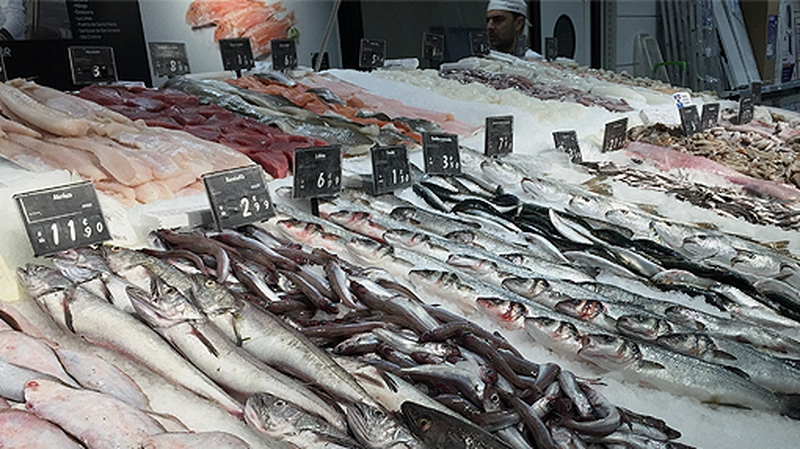
Fish is usually caught locally and the distance from the catching
point to the retailer is usually not long. Of course, there is fish and
seafood that are sold in EU and China, but we support can our economy
and environment by choosing fresh Irish fish with very few food miles.
We need to encourage young people to develop the healthy habit of eating fresh (not processed) fish.
The feed conversion ratio (FCR) is an indicator that is commonly used
in all types of farming which can provide a good indication of how
efficient a feed or a feeding strategy can be. It's the mathematical
relationship between the input of the feed that has been fed and the
weight gain of a population. The lower the FCR, the higher the weight
gain obtained from the feed. If FCR = 1, this means that we produce 1kg
of a species with 1kg of feed.
When applied to aquatic animals, FCR is generally lower than that of
land animals so we need less feed to produce the same amount of food.
Fish do not require drinking water. Therefore, both the carbon and the
water footprints of fish is superior to those of animals.
Average FCR
Omnivorous fish - 1.6
Farmed carnivorous marine - 1.45
Salmonids - 1.1
Pig - 2.75
Broiler (chicken) - 2.0
Beef cattle - 6.0
Dairy cattle - 8.0
Fish is healthy, tasty and green and we need to develop ways to
spread across this message and encourage young people to develop the
healthy habit of eating fresh (not processed) fish.
The views expressed here are those of the author and do not represent or reflect the views of RTÉ