Showing posts with label yogurt in nutrition. Show all posts

Friday, 25 October 2019

Shape up with Greek yogurt as a post-workout snack


source : Yogurt InNutrition

Next time you head for the gym, grab a pot of Greek yogurt as a post-workout snack. You may soon be reaping benefits!

This study suggests that if you’re wanting to build muscles and become body-beautiful, then it helps to do more than just pump weights.
Choosing what to eat after a workout is essential because that’s the time when your muscles are repairing themselves and your energy levels are low. Dairy proteins (mostly casein and whey) are a great source of amino acids for rebuilding muscle.
A combination of drinking milk and resistance exercise increases strength and muscle size and leads to a leaner physique. But what about other dairy products? Can they all contribute to boosting the physical effects of exercise? Greek yogurt – a fermented dairy product – is a promising candidate and makes a convenient and nutrient-rich post-workout snack, say the authors.
Greek yogurt is made by straining regular yogurt to remove more of the whey, and it is packed with protein (mostly casein). A 175 g pot of plain Greek yogurt provides about 17 g of protein. An equivalent amount of protein is found in two glasses of milk. So, Greek yogurt provides lots of protein in a conveniently sized portion, handy especially when you’re on the move.
Like milk, Greek yogurt contains key nutrients such as calcium and phosphorus that are essential for healthy bones. But there are important differences too. Greek yogurt has a thick creamy consistency which may mean you feel fuller for longer.
And as a fermented food, Greek yogurt contains bacteria that may have additional health benefits, help to improve digestion and support immunity, say the authors.
‘Greek yogurt contains 3 to 4-fold the amount of protein as regular yogurt.’ – Bridge et al, 2019.

Assessing the effects of Greek yogurt and exercise

In this study, young men who hadn’t been training regularly, entered a combined resistance training/plyometric (jump training) programme for 3 days per week for 12 weeks.
Half of them ate fat-free, plain Greek yogurt (20 g protein/serving) three times on training days – immediately post-exercise, 1 hour post-exercise and before bed. On non-training days, they ate the yogurt twice a day – at breakfast and before bed.
The other half of the young men formed a placebo group and consumed a carbohydrate-based pudding (no protein, but the same amount of energy as Greek yogurt) at these times instead.
Strength, thickness of upper arm (biceps) and thigh (quadriceps) muscles, and body composition were measured before the start of the exercise programme and again after 12 weeks.

Greek yogurt was associated with bigger muscles

After 12 weeks on the exercise programme, both groups enjoyed a significant increase in strength and muscle thickness. But the Greek yogurt group did best – they gained significantly more strength and biceps thickness than the placebo group.
Higher protein intake in the Greek yogurt group could explain the greater gains in strength and muscle size, say the authors.

Greek yogurt was associated with a healthier body composition

Muscles is denser than fat and so it comes as no surprise that both groups put on weight after 12 weeks on the exercise programme. But when it came to shedding body fat, the men in the Greek yogurt group were once again the winners.
High-protein Greek yogurt has been associated with reduced appetite and energy intake at mealtimes. Added to that, calcium in Greek yogurt may inhibit fat production and stimulate fat breakdown in the body, say the authors.
‘…Greek Yogurt should be considered as a viable post-exercise, whole food, protein source for individuals beginning a resistance training program with the goal of increasing strength and lean mass and decreasing fat mass.’ – Bridge et al, 2019.
Find out more: read the original article
Source: Bridge A, Brown J, Snider H et al. Greek yogurt and 12 weeks of exercise training on strength, muscle thickness and body composition in lean, untrained, university-aged males. Front Nutr. 2019;6:55.

Sunday, 8 July 2018

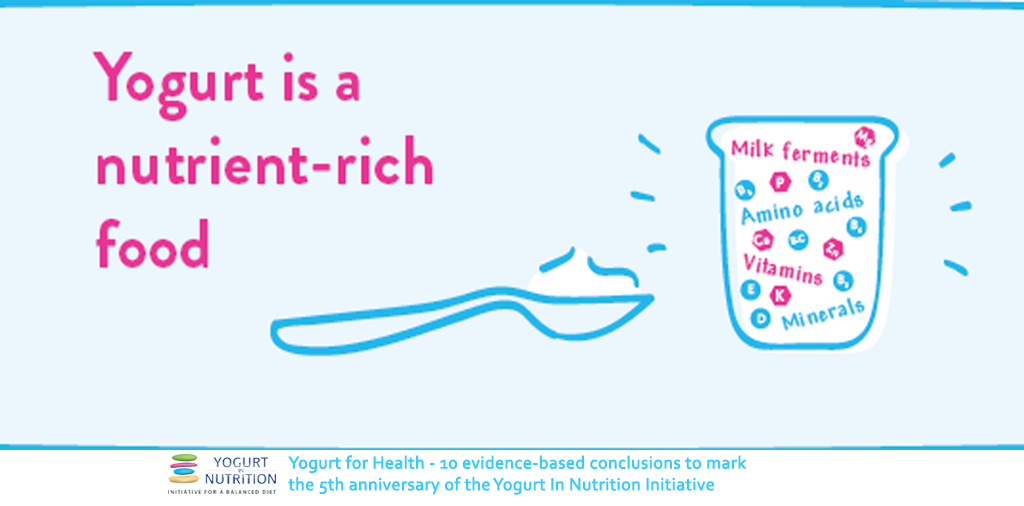
Yogurt for Health: 10 evidence-based conclusions


The Yogurt In Nutrition Initiative (YINI) was established in 2013 with the overall goal to achieve scientific knowledge on the health effects of yogurt and to share the findings with a broad audience.
The YINI represents a unique collaboration between two international scientific organisations - the American Society for Nutrition (ASN) and the non-profit organisation, Danone Institute International (DII). The activities of the initiative are guided by a Scientific Advisory Board of 15 world experts with a passion for advancing knowledge on the links between diet and health.

Over the past five years, the YINI has built a strong portfolio of resources: scientific meetings and proceedings, educational campaigns, printable and online materials. A YINI digital ecosystem includes the popular website, www.yogurtinnutrition.com
that provides news and practical information, and social media interfaces, such as Twitter with nearly 17,000 followers of @YogurtNutrition
.
Inspiring events and supporting innovative research
Each year, the YINI highlights topical areas of research into the scientific and clinical links that are emerging between yogurt and health. Themes include weight management, the risk of diabetes, lactose intolerance,fermentation, and children’s health. These themes are reflected in the annual YINI Global Summit on the Health
Effects of Yogurt, the proceedings of which are published in peer reviewed journals.

In order to stimulate further research advances and support scientists from around the world, the YINI provides a grant each year (US $30,000) and launches a Call for Research Proposals concerning a range of projects, focused on yogurt science. 
Find out how to apply at www.yogurtinnutrition.com/category/grant-application/
Celebrating the 5th YINI anniversary
Today, as we celebrate the YINI’s 5th anniversary, we can reflect on what has been achieved. In this document,
the YINI board reviews the recent advances in scientific understanding about the health effects of yogurt and draws several evidence-based conclusions. Overall, substantial accomplishments have been made in the past five years, highlighting exciting potential developments in managing health through yogurt as part of our diet.
Ongoing research is opening new doors — to a bright future.

===

our latest paper on dairy, it appears in Figure 1 (page 18); thanking the authors to including our work!
 Ioannis Zabetakis

Monday, 21 May 2018

Low-fat or full-fat fermented dairy products, such as yogurt, may benefit cardiovascular health

[reposting from here]


As latest research questions conventional dietary recommendations on dairy foods due to the properties of dairy fats, fermented dairy products such as yogurt, cheese and kefir, could prove to be a healthy choice for protecting against cardiovascular disease (CVD).

Dairy foods have long been believed to increase the risk of CVD due to their fats content and their association with increased cholesterol levels. In response, dietary guidelines in Western countries recommend limiting full-fat dairy products in favour of low-fat versions.
However, with recent evidence suggesting that systemic inflammation is the key biochemical driver of atherosclerosis and damage to the heart muscle, this advice and the science underlying it are now under debate, according to the authors of this review article.

High saturated fatty acid intake may not cause harmful cholesterol levels

Question marks have been raised over the science that suggested a causal relationship between a high intake of saturated fatty acids (SFA), high LDL-cholesterol, atherosclerosis and coronary heart disease.
Indeed, the authors say, despite high levels of SFAS, full-fat dairy foods have positive or at least neutral effects on cardiovascular health, while also contributing to higher intakes of nutrients such as vitamins D and K.

The focus is shifting to consider the effect of the fermented dairy food matrix on cardiovascular health

Research has moved away from focusing on single nutrients, such as saturated fat, towards considering the food matrix, the nutrient and non-nutrient components of foods and how they interact and affect body chemistry.
Researchers are also trying to pin down the specific effects of different types of dairy foods, including fermented products, such as yogurt, cheese and kefir, on cardiovascular health.

Fermented dairy products such as yogurt may hold potential benefits for cardiovascular health

Although fermented dairy products are often linked with gut health, they also appear to benefit cardiometabolic health, which encompasses cardiovascular and metabolic diseases, including type 2 diabetes (T2D) and the metabolic syndrome.
Higher consumption of cheese, yogurt and kefir is linked with lower levels of LDL-cholesterol and blood pressure, together with a lower risk of T2D, stroke and coronary heart disease (CHD). These potential benefits may increase the more you consume.

Yogurt in particular is associated with a reduced risk of cardiovascular diseases (CVD)

Yogurts in particular, with their diverse assortment of different bioactive, nutrient-rich compounds, especially when consumed with fruit, have been linked with a reduced risk of CVD, diabetes and metabolic syndrome – i.e.  high blood pressure, high blood glucose, large waist circumference and abnormal blood fats.

Choose fermented dairy products to optimise nutrient intake and potential cardiovascular health benefits

Exactly how fermented foods influence risk factors for CVD is yet to be uncovered. However, it is thought that probiotics and vitamin K2, which are both present in fermented dairy foods, may play a part.
The fermentation process itself may also have a role as it leads to changes in the structure of fats and proteins. These may account for some of the observed effects. There may also be benefits of full-fat dairy consumption based on higher bioavailability of high-value nutrients and anti-inflammatory and antioxidant properties.
Hence while full-fat dairy products can continue to be consumed in moderation as part of a healthy balanced lifestyle, choosing fermented dairy products is most likely to optimise nutrient intake and potential cardiovascular health benefits.
Find out more: read the original article

Source: Lordan R, Tsoupras A, Mitra B, Zabetakis I. Dairy fats and cardiovascular disease: do we really need to be concerned? Foods 2018 Mar 1;7(3)

To go further, we invite you to read the authors’ post on the topic: “Dairy fats and cardiovascular disease: Do we really need to be concerned?“

Friday, 6 April 2018

enjoy your full-fat fermented dairy !


Ronan Lordan and Ioannis Zabetakis are both researchers at the University of Limerick in Ireland in the Department of Biological Sciences. They along with their colleagues recently authored a review in which they examine the effect of dairy products on the development of cardiovascular diseases. Among their findings, they noted that fermented dairy products such as yogurt and kefir had a neutral or positive effect on cardiovascular outcomes.


[you can read the full story here]