A must read article
Front. Nutr., 19 June 2023Sec. Clinical Nutrition
Volume 10 - 2023 | https://doi.org/10.3389/fnut.2023.1020678
Background: Clinical studies on effects of marine-derived omega-3 (n-3) polyunsaturated fatty acids (PUFAs), mainly eicosapentaenoic acid (EPA) and docosahexaenoic acid (DHA), and the plant-derived omega-6 (n-6) PUFA linoleic acid (LA) on lipoprotein-lipid components and glucose-insulin homeostasis have shown conflicting results, which may partly be explained by differential responses in females and males. However, we have lacked data on sexual dimorphism in the response of cardiometabolic risk markers following increased consumption of n-3 or n-6 PUFAs.
Objective: To explore sex-specific responses after n-3 (EPA + DHA) or n-6 (LA) PUFA supplementation on circulating lipoprotein subfractions, standard lipids, apolipoproteins, fatty acids in red blood cell membranes, and markers of glycemic control/insulin sensitivity among people with abdominal obesity.
Methods: This was a randomized double-blind crossover study with two 7-week intervention periods separated by a 9-week washout phase. Females (n = 16) were supplemented with 3 g/d of EPA + DHA (fish oil) or 15 g/d of LA (safflower oil), while males (n = 23) received a dose of 4 g/d of EPA + DHA or 20 g/d of LA. In fasting blood samples, we measured lipoprotein particle subclasses, standard lipids, apolipoproteins, fatty acid profiles, and markers of glycemic control/insulin sensitivity.
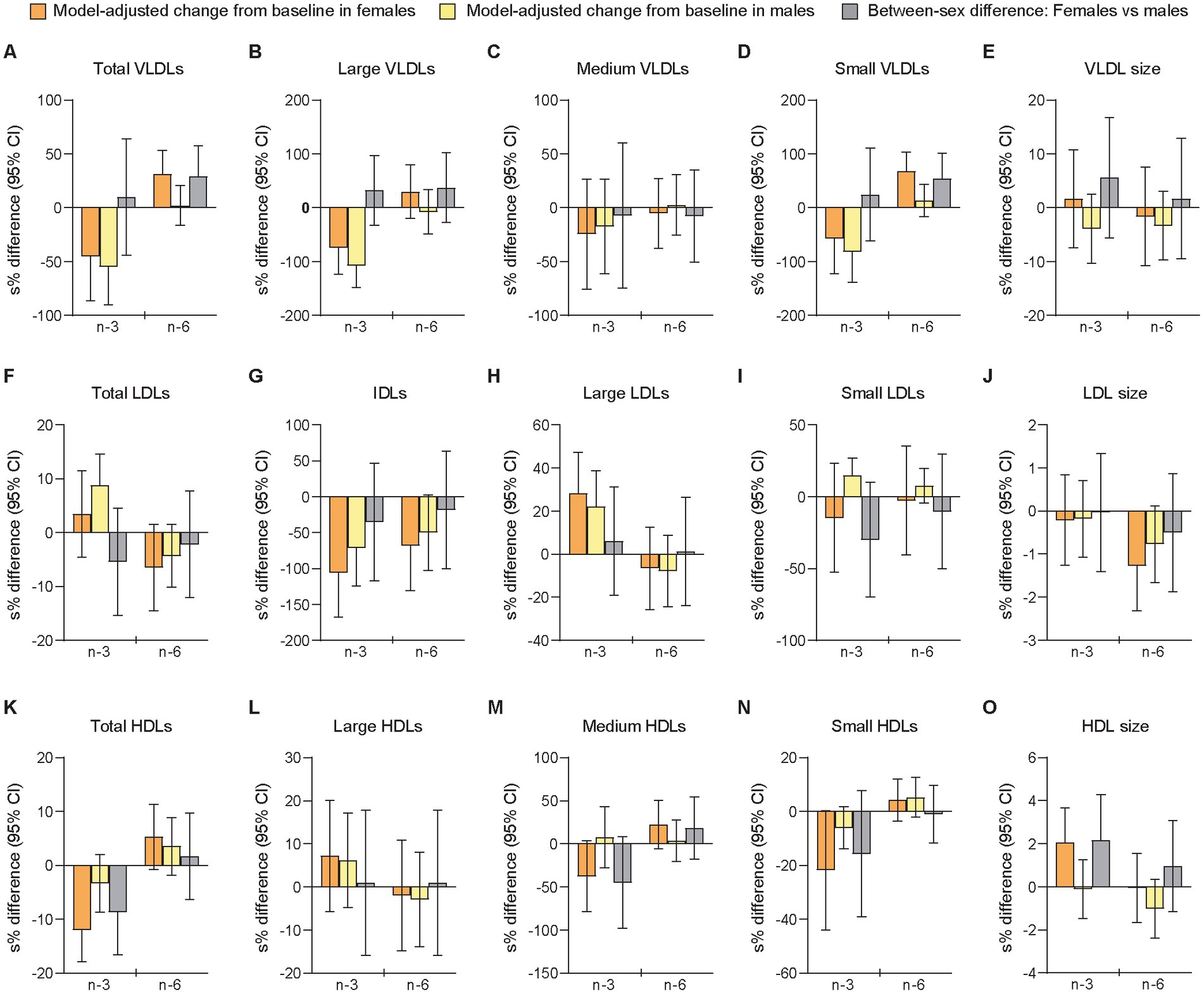
Results: The between-sex difference in relative change scores was significant after n-3 for total high-density lipoproteins (females/males: −11%*/−3.3%, p = 0.036; *: significant within-sex change), high-density lipoprotein particle size (+2.1%*/−0.1%, p = 0.045), and arachidonic acid (−8.3%*/−12%*, p = 0.012), and after n-6 for total (+37%*/+2.1%, p = 0.041) and small very-low-density lipoproteins (+97%*/+14%, p = 0.021), and lipoprotein (a) (−16%*/+0.1%, p = 0.028). Circulating markers of glucose-insulin homeostasis differed significantly after n-3 for glucose (females/males: −2.1%/+3.9%*, p = 0.029), insulin (−31%*/+16%, p < 0.001), insulin C-peptide (−12%*/+13%*, p = 0.001), homeostasis model assessment of insulin resistance index 2 (−12%*/+14%*, p = 0.001) and insulin sensitivity index 2 (+14%*/−12%*, p = 0.001), and quantitative insulin sensitivity check index (+4.9%*/−3.4%*, p < 0.001).
Conclusion: We found sex-specific responses after high-dose n-3 (but not n-6) supplementation in circulating markers of glycemic control/insulin sensitivity, which improved in females but worsened in males. This may partly be related to the sex differences we observed in several components of the lipoprotein-lipid profile following the n-3 intervention.