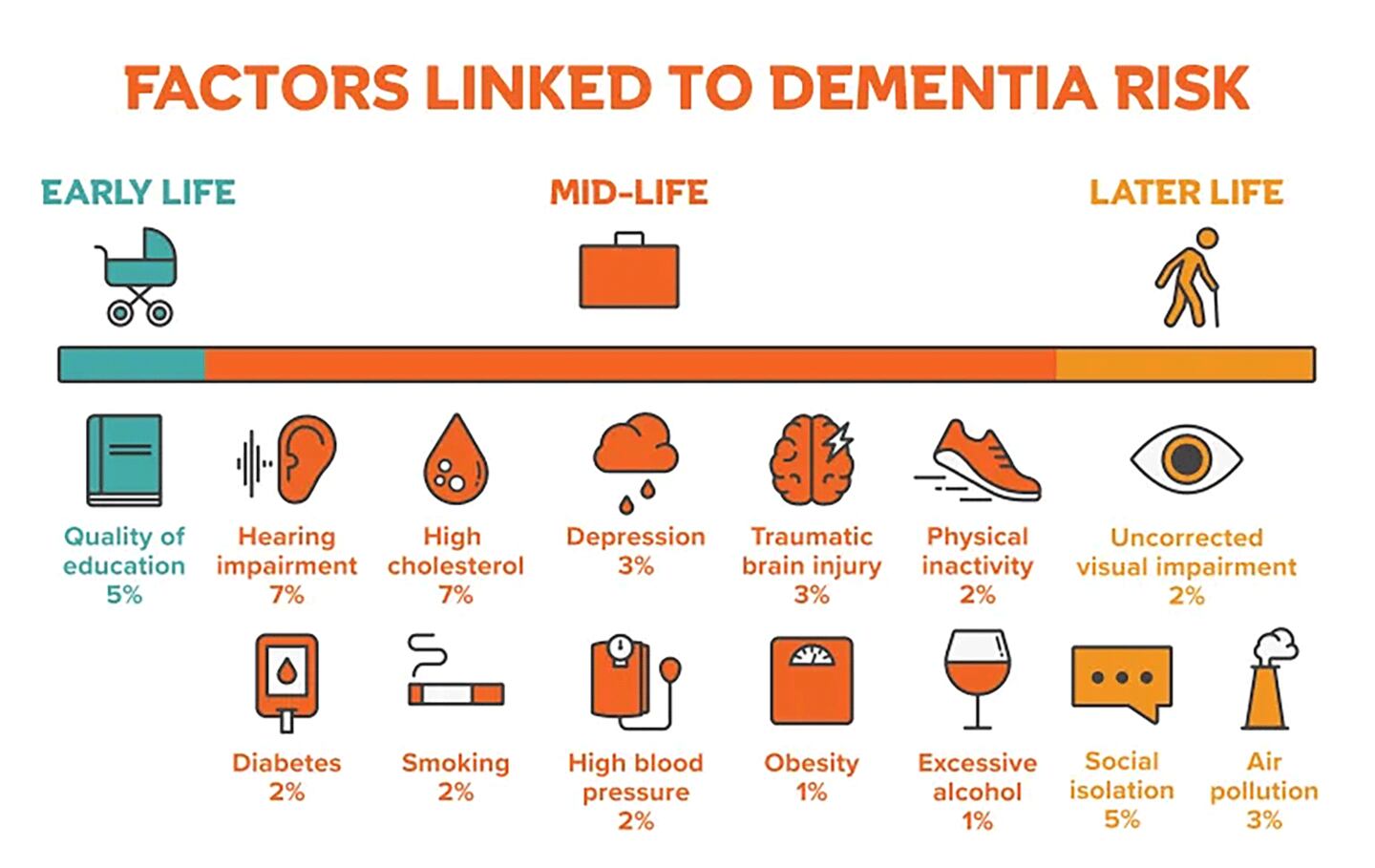
Factors linked to dementia. Graphic: UK Alzheimer’s Society
from the Irish Times / the article is behind a paywall so you can read it here.
Merits of simple lifestyle changes to curb risk of dementia have never been so compelling
There may be no cure yet for Alzheimer’s disease, a leading cause of death in most developed countries including Ireland, but 2024 has brought a succession of breakthroughs.
They range across drugs reducing rogue proteins in the brain linked to the disease, blood tests enabling rapid and more accurate diagnosis, and growing evidence that specific lifestyle changes can reduce risk of Alzheimer’s by up to 50 per cent.
Geriatrician Prof Seán Kennelly, clinical lead in the Memory Assessment Clinic at Tallaght University Hospital, agrees these are “very exciting” advances.
He tries to avoid hype. “I’m always conscious that there are people who are living, and supporting the care of somebody, with dementia now – they’re at a stage whereby these treatments are probably not going to be effective.”
Tantalisingly, the breakthroughs bring us closer to reversing Alzheimer’s while evidence continues to emerge that something as simple as integrating a healthy lifestyle can reverse symptoms of the disease.
The biggest news for Kennelly is confirmation of the first medicine in 20 years for treating Alzheimer’s. “We finished the year with the recommendation from the European Medicines Agency (EMA) for Lecanemab ... this is the first medicine that we know removes this culprit protein – amyloid – which is responsible for causing Alzheimer’s disease.”
It is different from early treatments known as cognitive enhancers. “They didn’t alter trajectory of the illness. They really just helped with symptoms for a short period of time in a small number of people.”
We are moving into “a new era of chemotherapy” where it’s becoming like the treatment paradigm for cancer, he says. “It’s around timely and specific diagnosis, and we have new tests to help us diagnose Alzheimer’s disease ... and then delivery of medicines at earlier stages of the condition, because these proteins build up in the brain about 15 to 20 years before people have clinical symptoms.”
The EU is about to rule on licensing Lecanemab. Public reimbursement then arises in the national context, with a HSE process expected to be completed within a year. Analysis indicates 10 per cent of people who come through the memory clinic every year will benefit.
“These are like the first chemotherapies we would have had for cancer. They’re more dangerous than we’d like, and they’re less effective than we’d like.” Lecanemab is a drip administered every two weeks. Donanemab, which the EMA will adjudicate on shortly, is a monthly infusion. Soon injections under the skin mean people may not need to have infusions at all.
The era of targeting these proteins at an early stage to minimise risk of Alzheimer’s progressing has started. The prospect of it becoming a managed condition, such as HIV or diabetes, is very real. “Five years ago that was pretty much unthinkable,” Kennelly says.
“As these new medicines become available for people with little or no symptoms, more people at that milder stage will start presenting,” he explains – which will push that 10 per cent upwards.
Since 2016, the clinic has been doing more than 200 CSF lumbar tests a year, numbing the lower back, extracting cerebrospinal fluid and measuring amyloid and tau – the culprit proteins – the main route to definitive diagnosis.
He expects a blood test will be available within two years. New blood tests are as good as the CSF test and more advanced imaging tests.
A blood test called pTau217 looks as accurate as the CSF test or amyloid PET scans. The FDA in the US has already approved some of these tests, while applications are with the EMA. They are much easier to do, while a PET scan costing €2,500 are not as successful and require radiation.
As with cancer treatment, you need to have “accurate biology” to start chemotherapy. “That’s why these two streams of better diagnosis happening alongside better treatment potentials is what has a lot of excitement for what is in the developed world probably the main cause of illness as we grow older now.”
Better management of dementia will bring wide-scale benefits, Kennelly predicts. “Dementia is the common thread of frailty as we get older. It’s the main predictor somebody will have difficulty managing in their own home. It’s the main reason why people end up going into nursing homes ... why people have falls when they grow older, why they have incontinence.”
The life expectancy of somebody born in 2021 is about 105 years of age by current evidence “but we have this health span gap between the length of time people are healthy versus the length of time they’re living” – and the main cause nowadays is dementia.
“What we know is an 80-year-old today is 40 per cent less likely to develop or have dementia than an 80-year-old 40 years ago. But we have so many more 80-year-olds now.”
While innovation is moving quickly, many are still in the early stages of real-world application, says Dr Laura O’Philbin, research and policy manager at the Alzheimer Society of Ireland.
“Amid this excitement, we must also remember the 64,000 people already living with dementia in Ireland, who need services and supports to live as well as possible for as long as possible,” she adds.
“Nobody is stopping the fight to try and find better treatments for people with advanced symptoms,” Kennelly states, but most of the good news this year and most of these new treatments are going to be focused on that group of people who don’t have significant symptoms.”
He often says “this is the best news people didn’t know they needed, because many of the people who will probably benefit from them don’t know that these proteins are building up in their brain – and have no symptoms right now”.
The merits of simple lifestyle changes to curb risk of dementia, and its most common form, Alzheimer’s disease, have never been so compelling but the range of advice can seem overwhelming.
“About 40 to 50 per cent of all of our risk for developing dementia is modifiable. So people do have power to alter that risk,” says Kennelly.
Fortunately, the Lancet Commission on Dementia provides clarity. It gathers 27 of the world’s leading dementia specialists to distil evidence and update advice. Its latest report published in July confirmed almost half of dementia cases worldwide can be prevented or delayed.
Its finding that far more cases could be avoided or delayed than previously thought was seismic. The modifiable risk factors, starting in childhood and continuing throughout life, could prevent or delay 45 per cent of dementia cases, even as people live longer, it concluded.
Healthy lifestyles involving regular exercise, not smoking, cognitive activity in midlife – including outside formal education – and avoiding excess alcohol can lower risk but may also push back dementia onset.
“There is much more that millions of people could and should do to reduce the risk of dementia. Many people around the world believe dementia is inevitable but it’s not,” said lead author Prof Gill Livingston.
There is stronger evidence that longer exposure to risk has a greater effect, yet it shows it’s never too early or late to take action.
Their report adds two risk factors associated with 9 per cent of dementia cases. About 7 per cent of cases are linked to high low-density lipoprotein (LDL) – or “bad” cholesterol – in midlife from about the age of 40, while 2 per cent of cases are attributable to untreated vision loss in later life.
The new risk factors are in addition to 12 identified in 2020. They are lower levels of education; hearing impairment, high blood pressure, smoking, obesity, depression, physical inactivity, diabetes, excessive alcohol consumption, traumatic brain injury, air pollution and social isolation.
Age and genetics, however, remain the biggest risk factors for dementia, while women are more likely to get the disease.
Kennelly helps run Ireland’s first brain health clinic for people with mild memory symptoms which helps with behavioural changes by providing a support infrastructure. “So how do you get to exercise? What is the best diet? How do you get to a best diet? How do you improve your social network? We check their vision and hearing. [It] emphasises the whole potential to prevent dementia.”
In explaining to patients, he compares the approach to SSIAs – the savings scheme in which the State topped up deposits by individuals – “in that later investment offers and brings a better value outcome. We know that doing this later in life, actually you get an even amplified effect because your risk is so much higher”.
“So people doing all the good stuff at 40 is a good thing ... if you stop doing it at 50, you’re still accruing risk at that stage whereas if we can really get people at the age of 60 into doing more exercise, better diets, better social connectivity, getting their eyesight and their hearing checked.”
Hearing loss is a big risk factor, Kennelly underlines. “And people won’t be aware of it because your brain will always tell you your hearing is fine. You can’t hear what you haven’t heard. So you have to get these things formally checked by a third party.”
And there is “really strong evidence” for a 40 per cent reduction in risk of developing dementia with the shingles vaccine, he adds – the same for the flu vaccine. By turning down the immune system or inflammatory response within the body, vaccination seems to be very effective at reducing risk, though the effect is not fully understood.
The shingles vaccine costs about €500, but given the health dividend, Kennelly says the cost should be fully reimbursed in Ireland – as it is in the UK.
It is never too early or too late to start thinking about our brain health and taking early steps to reduce our risk of dementia, says Dr Laura O’Philbin of the Alzheimer Society of Ireland. While there is no one specific method or treatment proven to prevent dementia, there are lifestyle changes we can make and strategies we can adopt to lower our risk.
However, she adds, brain health is not just about individual choice as it is intrinsically linked to social inequalities. “Factors such as poverty, ethnicity, and geographic location significantly impact access to education, healthcare, and air quality, all of which influence dementia risk.”
= = = =
In UL, with my research team, we have started working on this topic. One of our latest publication is this one:
Background
Pro-inflammatory processes triggered by the accumulation of extracellular amyloid beta (Aβ) peptides are a well-described pathology in Alzheimer's disease (AD). Activated astrocytes surrounding Aβ plaques contribute to inflammation by secreting proinflammatory factors. While astrocytes may phagocytize Aβ and contribute to Aβ clearance, reactive astrocytes may also increase Aβ production. Therefore, identifying factors that can attenuate astrocyte activation and neuroinflammation and how these factors influence pro-inflammatory pathways is important for developing therapeutic and preventive strategies in AD. Here, we identify the platelet-activating factor receptor (PTAFR) pathway as a key mediator of astrocyte activation. Intriguingly, several polar lipids (PLs) have exhibited anti-inflammatory protective properties outside the central nervous system through their inhibitory effect on the PTAFR pathway. Thus, we additionally investigated whether different PLs also exert inhibitory effects on the PAF pathway in astrocytes and whether their presence influences astrocytic pro-inflammatory signaling and known AD pathologies in vitro.
Methods
PLs from salmon and yogurt were extracted using novel food-grade techniques and their fatty acid profile was determined using LC/MS. The effect of PLs on parameters such as astrocyte activation and generation of oxygen species (ROS) was assessed. Additionally, effects of the secretome of astrocytes treated with these polar lipids on aged neurons was measured.
Results
We show that PLs obtained from salmon and yogurt lower astrocyte activation, the generation of reactive oxygen species (ROS), and extracellular Aβ accumulation. Cell health of neurons exposed to the secretome of astrocytes treated with salmon-derived PLs and Aβ was less affected than those treated with astrocytes exposed to Aβ only.
Conclusion
Our results highlight a novel underlying mechanism, why consuming PL-rich foods such as fish and dairy may reduce the risk of developing dementia and associated disorders.

