The question that now faces the world is a stark one: can humans
concentrate their collective minds without an external enemy?
Photograph: Getty
--------------------
Fintal O'Toole, Irish Times, 6th November 2021
-------------------------------------------------------------------------
"Depend upon it, sir,” said Samuel Johnson,
“when a man knows he is to be hanged in a fortnight, it concentrates
his mind wonderfully”. We do indeed have to depend upon the Cop26 summit
proving Johnson right, and that the threat of extinction will
concentrate the collective mind.
There
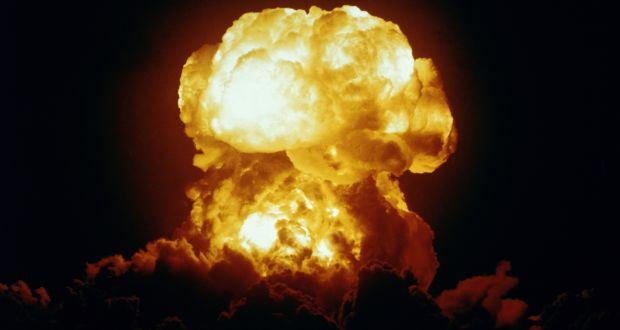
are, at least, some precedents. One of them is, ironically, the origin
of the great fear that has now been displaced by climate change: nuclear
war.
Over Christmas in 1938, two physicists, Lise Meitner and her nephew Otto Frisch,
had a startling insight. They realised that if you bombarded a uranium
nucleus with a neutron, it could split into two, releasing a great
amount of energy.
It
very quickly dawned on scientists that this could become a chain
reaction, producing more and more energy. That process could, in theory,
be harnessed to make a bomb of unprecedented destructiveness.
In
the spring of 1940, Frisch and Rudolf Peierls, having, like Meitner,
fled from the Nazis, arrived in Birmingham. There they figured out
something even more alarming – a lump of uranium-235 the size of a golf
ball would be enough to make such a bomb.
An
even darker thought followed – if they had worked this out, then surely
the brilliant colleagues they had left behind in Germany must have done
the same. Hitler might well be working on an atomic bomb.
This
was, as Jewish people already knew, an existential threat. If Hitler
had the bomb and his enemies did not, he would certainly use it. “As a
weapon,” Frisch and Peierls warned Winston Churchill,
“the super-bomb would be practically irresistible”. They argued the
imperative of developing an atomic bomb as a “counter-threat”.
Extraordinary
What
happened next was an extraordinary concentration of the mind.
Churchill, who himself had already foreseen the possibility that the
splitting of the atom could lead to a new and fearful kind of weaponry,
alerted US president Franklin D Roosevelt.
Out of this dread came a staggering
achievement. The Manhattan Project really got under way in September
1942. The first atomic bomb was exploded less than three years later, in
July 1945.
The horrors of Hiroshima and Nagasaki make it hard to celebrate this achievement. But it was, in itself, stunning.
Creating
the atomic bomb was actually much more difficult than the scientists
had imagined. It required an unprecedented concentration of industrial
might, scientific brilliance, governmental commitment and vast public
resources.
The reason all of this came together was
existential dread: terror of the Nazis and what they would do if they
got the bomb first. The prospect of being hanged in a fortnight made
what was scarcely possible an achievable reality.
The great irony, of course, is
that this remarkable accomplishment in fact added to the common store of
dread. Nuclear weapons, initially a guarantor against extinction,
became themselves the bearers of the threat that humanity might
obliterate itself.
I
sometimes wonder whether one of the deep-lying reasons for the failure
of governments and societies to acknowledge the peril of climate change
was a kind of dread fatigue.
Everyone
who lived through the cold war also lived with a burden of anxiety: the
knowledge that an apocalyptic conflagration would trigger the nuclear
winter in which most life on Earth would perish. It was a constant
background noise that, at moments of crisis, came to the fore and became
overwhelming.
It
was perhaps unfortunate that the first report of the Intergovernmental
Panel on Climate Change was published in 1990, just after the fall of
the Berlin Wall. One burden of terror was being lifted, but here was
another coming along right on cue to take its place.
Existential anxiety
Perhaps
it was natural to think: give us a break. Perhaps humankind needed a
holiday from existential anxiety. But the effusion of greenhouse gases
did not take a vacation – it just kept going.
Maybe
there has also been a paradoxical hangover from the cold war – the
worst did not happen. The hard rain did not fall. The eve of destruction
was not followed by the dark night of annihilation.
Maybe
the period between 1989 and the Paris Agreement of 2015 can be seen as
humanity’s long exhale, a sigh of relief that the great danger had
apparently passed and we were safe now.
There
was a deep desire not to know this was the ultimate false sense of
security. It was a pleasant illusion to imagine that, since we got away
with the game of chance that was mutually assured destruction, we would
get away with every other form of dicing with death.
Indulgence
in that illusion has led us to the present crisis. The question that
now faces the world is a stark one: can humans concentrate their
collective minds without an external enemy?
The great fusions of politics,
technology, industry and science – like the Manhattan Project and the
Apollo moonshot – have been driven by warlike competition.
Without
the fear of the Nazis, the atom bomb would not have been developed at
such dizzying speed. Without the space race between the Americans and
the Soviets, there would have been no man on the moon.
A
pessimist might say that this is precisely the problem with climate
change. There is no Them, only an Us. We are our own worst enemy, and we
have to be our own bogeyman. We have to scare ourselves into action.
It is war that has typically speeded up
history by galvanisng the idea of a threat that must be countered,
whatever the cost. It is competition for dominance that has spurred
governments to undertake the seemingly impossible.
But
now we face a threat that cannot be countered by competition between
nations. It can be met only by co-operation on a truly global
scale. Survival demands that we be afraid, not of each other, but for
each other, and for all the others not yet born.
What
we know, however, is that the concentration of the mind produces
amazing results. If political systems really want to, they can harness
science, technology, government, economics and industry to the same
wagon. And then things can move with extraordinary rapidity.
Can that willpower be generated without war?
More than a century ago, George Bernard Shaw,
in Man and Superman, had the Devil suggest that “in the arts of life,
man invents nothing, but in the arts of death, he outdoes nature
herself”. But we can no longer outdo, or outrun, nature.
If
half the money, ingenuity and energy that has been devoted to the arts
of death is channelled into the rapid decarbonisation of the global
economy, it will be achieved.
The
gallows we have built for ourselves does not have to be ascended. We
have the power, seldom granted to those who have committed capital
crimes against nature, to grant ourselves a reprieve.


:quality(70)/cloudfront-eu-central-1.images.arcpublishing.com/irishtimes/5OI5ZNU3VDULEU5SSZKADGFY4M.jpg)