 |
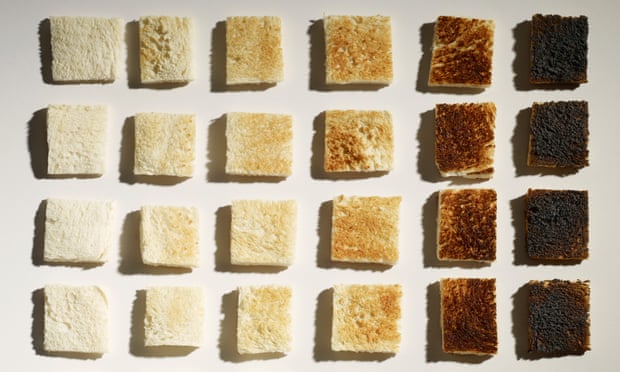
| The UK Food Standards Agency has launched the Go for Gold campaign to urge the public to avoid singeing their toast or leaving roast potatoes to char in the oven. Photograph: Tim Macpherson/Getty Images |
from the Guardian:
In October 1997, something troubling was happened around the Hallandsås ridge in southwestern Sweden. Farmers had found cows paralysed or dead in their fields, lifeless fish were spotted floating in a local river and workers at a construction site began suffering from nausea and prickling sensations in their fingers.
source: How burnt toast and roast potatoes became linked to cancer
= = =
The point here is NOT whether acrylamide is directly linked to cancer or not.
The point here should be what the industry and ourselves in our every day practice, we can do to minimise our exposure to cancer risk factors...
This acrylamide story reminded me our project on heavy metals in food tubers, where we had analysed the levels of Ni and Cr in food tubers grown using polluted irrigation water. One can claim that our research has not changed anything major...

Is this true though?
It has definitely changed our views towards Ni and Cr and
our work has been communicated, via greek FSA, EFET, to EFSA. EFSA has worked on this matter and has issued these two scientific opinions
1.Scientific Opinion on the risks to public health related to the presence of nickel in food and drinking water
Overall, the CONTAM Panel concluded that, at the current levels of acute dietary exposure to Ni, there is a concern that Ni-sensitized individuals may develop eczematous flare-up skin reactions. The CONTAM Panel noted the need for mechanistic studies to assess the human relevance of the effects on reproduction and development observed in experimental animals and for additional studies on human absorption of nickel from food, for example in combination with duplicate diet studies.
2.Scientific Opinion on Dietary Reference Values for chromium
The Panel concludes that no Average Requirement and no Population Reference Intake for chromium can be defined. Several studies assessed the effect of chromium supplementation on glucose and/or lipid metabolism. In the only study for which information on total chromium intake was available, there was no difference in parameters of glucose metabolism of normoglycaemic subjects between the placebo and chromium-supplemented periods. The Panel considered that there is no evidence of beneficial effects associated with chromium intake in healthy subjects. The Panel concluded that the setting of an Adequate Intake for chromium is also not appropriate.
= = =
Food Toxicity is a massive topic, often underestimated...Articles such as this one of Hannah Devlin though are very useful in multiple ways.
