Showing posts with label nutrients. Show all posts

Tuesday, 30 August 2022

Effective food hygiene principles and dietary intakes to reinforce the immune system for prevention of COVID-19: a systematic review

 this is a paper of great interest!


Abstract

Background

This study aimed at reviewing effective food hygiene principles and dietary intakes to reinforce the immune system for prevention of corona virus disease 2019 (COVID-19).

Methods

The systematic literature search was performed in three databases from Jan. 2020 up to 10th July 2020. English articles that focused on nutrition, food, immunity and corona virus were searched. Systematic and narrative reviews were included.

Results

After evaluation of search papers, 27 relevant articles were used in this review. The importance of nutrients, phytochemicals, probiotics and some spices were highlighted for enhancing immunity during the COVID-19 pandemic. A healthy dietary pattern with proper energy intake provides sufficient nutrients. The unhealthy dietary pattern is linked with inflammation and risk factors related to high mortality in patients with severe COVID-19 infection. Different thermal procedures have been used for the inactivation of viruses. It is recommended not to consume raw or undercooked animal products.

Conclusions

It is critical to ensure that the nutritional needs of the population are met and sustained based on standards during a COVID-19 pandemic. Clear advice on adequate calorie intake and an optimal healthy diet to support the immune function should be provided. Good hygiene practices must be performed by everyone and done in the food industry.

Friday, 29 January 2021

Dietary Habits, Selenium, Copper, Zinc and Total Antioxidant Status in Serum in Relation to Cognitive Functions of Patients with Alzheimer’s Disease


Paper on Nutrients 

Eating fewer legumes, cottage cheese and sausages and more flour products, honey, meat and poultry may have a beneficial effect on the antioxidative status of Alzheimer’s patients, researchers find.

Abstract:

Oxidative stress plays a crucial role in the neurodegenerative process and can impair cognitive functions. In the prevention of Alzheimer’s disease (AD), an adequate consumption of dietary antioxidants may be a major factor. The objective of the study was to estimate selenium (Se), copper (Cu), zinc (Zn), and total antioxidant status (TAS) in the serum of patients with AD in relation to their cognitive functions and dietary habits. A total of 110 patients (aged 54–93 years) with early or moderate AD, as well as 60 healthy people (aged 52–83 years) were studied. The severity of the disease was assessed using the mini-mental state examination (MMSE) scale. Food-frequency questionnaires were implemented to collect the dietary data. The concentrations of Se, Cu and Zn in the sera were determined by the atomic absorption spectrometry method. TAS was estimated spectrophotometrically using ready-made kits (Randox). Significantly lower concentrations of Se, Zn and TAS, and higher Cu:Zn ratio in the serum of patients with AD, compared to healthy people, were observed. A low correlation between the MMSE score and TAS in the serum of AD patients and significantly higher MMSE values in patients with TAS above the reference range were also noted. In patients with serum Cu concentration above the norm, significantly lower MMSE values were found. Selected dietary habits such as the frequency of consumption of various food products had a significant impact on the concentration of the assessed parameters in the serum of people with AD.

Wednesday, 20 May 2020

new paper from our team: "COVID-19: The Inflammation Link and the Role of Nutrition in Potential Mitigation "

COVID-19: The Inflammation Link and the Role of Nutrition in Potential Mitigation 

 
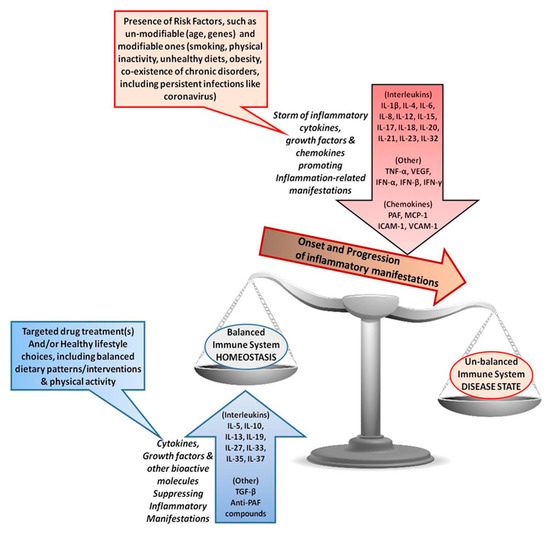
A reepresentation of the inflammatory molecules involved in infection and how certain dietary components may interact with them. Included are the cytokines, growth factors, and other chemokines that promote the onset and progression of inflammatory manifestations, dysregulation of the immune system, and a diseased state due to the effects of several unmodifiable and modifiable risk factors. Targeted drug treatments and/or healthy lifestyle choices such as balanced diets and physical activity can counterbalance such inflammatory manifestations towards homeostasis.
 
 
1
Department of Biological Sciences, University of Limerick, Limerick V94 T9PX, Ireland
2
Health Research Institute, University of Limerick, Limerick V94 T9PX, Ireland
3
Institute for Translational Medicine and Therapeutics, Perelman School of Medicine, University of Pennsylvania, Philadelphia, PA 19104-5158, USA
4
Department of Physical Education and Sport Sciences, University of Limerick, Limerick V94 T9PX, Ireland
Received: 22 April 2020 / Revised: 11 May 2020 / Accepted: 17 May 2020 / Published: 19 May 2020
 

Abstract

The novel coronavirus disease (COVID-19) pandemic caused by severe acute respiratory syndrome coronavirus 2 (SARS-CoV-2) has engulfed the world, affecting more than 180 countries. As a result, there has been considerable economic distress globally and a significant loss of life. Sadly, the vulnerable and immunocompromised in our societies seem to be more susceptible to severe COVID-19 complications. 
Global public health bodies and governments have ignited strategies and issued advisories on various handwashing and hygiene guidelines, social distancing strategies, and, in the most extreme cases, some countries have adopted “stay in place” or lockdown protocols to prevent COVID-19 spread. Notably, there are several significant risk factors for severe COVID-19 infection. 
These include the presence of poor nutritional status and pre-existing noncommunicable diseases (NCDs) such as diabetes mellitus, chronic lung diseases, cardiovascular diseases (CVD), obesity, and various other diseases that render the patient immunocompromised. 
These diseases are characterized by systemic inflammation, which may be a common feature of these NCDs, affecting patient outcomes against COVID-19. 
In this review, we discuss some of the anti-inflammatory therapies that are currently under investigation intended to dampen the cytokine storm of severe COVID-19 infections. Furthermore, nutritional status and the role of diet and lifestyle is considered, as it is known to affect patient outcomes in other severe infections and may play a role in COVID-19 infection. 
This review speculates the importance of nutrition as a mitigation strategy to support immune function amid the COVID-19 pandemic, identifying food groups and key nutrients of importance that may affect the outcomes of respiratory infections.


The background story of this paper is here. 


Monday, 18 May 2020

covid-19, NCDs, and food: the missing link?

Last March 30th, I sent an email with a couple of lines to my colleagues, Catherine, Alexandros and Ronan. 

It was a short email: the title of this blogpost with an attached file. The file contained a draft paper, two pages long, titled "Covid-19, Food and Chronic Diseases: the inflammation link".

We have been working on inflammation for a number of years (my first paper on PAF, atherosclerosis and food was published in 2000; it was on ....fried cod; fish and chips was the inspiration - I was lecturing in Leeds then :).

Fast forward to 2018, we (Ronan, Alex) wrote a paper on inflammation and CVDs with a rather radical title. Today, 2 years and few days later, that paper has few downloads and citations. We knew that we were after sth valid...

What about covid-19 though?

On 23rd March, the World Health Organisation (WHO) issued guidelines on the link between COVID-19 and non-communicable diseases (NCDs).


The link between non-communicable diseases (NCDs) and COVID-19


It was then when I whispered to myself : hey Yannis, hang on. What's going on here? 
All the discussions  I had with Alex and Ronan at Scholars in UL, with Nikola Tesla watching us, came to mind. So many cappuccinos for me, teas for Ronan and mochas for Alex discussing cardiovascular diseases, platelet aggregation, statins and their non-impact on cardiovascular risk, the vested interests on statins and omega3, cancer, mental disorders, neutral lipids, polar lipids, med diet, food pyramids, obesity etc etc...
And Nikola watching us all the time...
Sometimes, as we were leaving Scholars, I was smiling to Nikola...


That March 30th email was transformed to a review paper that was accepted yesterday and should appear very soon in Nutrients.    
 
"COVID-19: The Inflammation Link and the Role of Nutrition in Potential Mitigation"

 
Received: 22 April 2020; Accepted: 17 May 2020; Published: date

The purpose of this blogpost is double:

a. to thank Catherine, Alexandros and Ronan for all their collective efforts to produce a strong paper in only 23 days under #lockdown and 

b. to remind my spititual children (ie my students) that in Science, there is no parthenogenesis. 

If you work hard on something, good ideas will come.