Showing posts with label hyperlipidemia. Show all posts

Tuesday, 26 September 2023

Sex-specific responses in glucose-insulin homeostasis and lipoprotein-lipid components after high-dose supplementation with marine n-3 PUFAs in abdominal obesity: a randomized double-blind crossover study

A must read article

Front. Nutr., 19 June 2023
Sec. Clinical Nutrition

Volume 10 - 2023 | https://doi.org/10.3389/fnut.2023.1020678


Background: Clinical studies on effects of marine-derived omega-3 (n-3) polyunsaturated fatty acids (PUFAs), mainly eicosapentaenoic acid (EPA) and docosahexaenoic acid (DHA), and the plant-derived omega-6 (n-6) PUFA linoleic acid (LA) on lipoprotein-lipid components and glucose-insulin homeostasis have shown conflicting results, which may partly be explained by differential responses in females and males. However, we have lacked data on sexual dimorphism in the response of cardiometabolic risk markers following increased consumption of n-3 or n-6 PUFAs.

Objective: To explore sex-specific responses after n-3 (EPA + DHA) or n-6 (LA) PUFA supplementation on circulating lipoprotein subfractions, standard lipids, apolipoproteins, fatty acids in red blood cell membranes, and markers of glycemic control/insulin sensitivity among people with abdominal obesity.

Methods: This was a randomized double-blind crossover study with two 7-week intervention periods separated by a 9-week washout phase. Females (n = 16) were supplemented with 3 g/d of EPA + DHA (fish oil) or 15 g/d of LA (safflower oil), while males (n = 23) received a dose of 4 g/d of EPA + DHA or 20 g/d of LA. In fasting blood samples, we measured lipoprotein particle subclasses, standard lipids, apolipoproteins, fatty acid profiles, and markers of glycemic control/insulin sensitivity.

Results: The between-sex difference in relative change scores was significant after n-3 for total high-density lipoproteins (females/males: −11%*/−3.3%, p = 0.036; *: significant within-sex change), high-density lipoprotein particle size (+2.1%*/−0.1%, p = 0.045), and arachidonic acid (−8.3%*/−12%*, p = 0.012), and after n-6 for total (+37%*/+2.1%, p = 0.041) and small very-low-density lipoproteins (+97%*/+14%, p = 0.021), and lipoprotein (a) (−16%*/+0.1%, p = 0.028). Circulating markers of glucose-insulin homeostasis differed significantly after n-3 for glucose (females/males: −2.1%/+3.9%*, p = 0.029), insulin (−31%*/+16%, p < 0.001), insulin C-peptide (−12%*/+13%*, p = 0.001), homeostasis model assessment of insulin resistance index 2 (−12%*/+14%*, p = 0.001) and insulin sensitivity index 2 (+14%*/−12%*, p = 0.001), and quantitative insulin sensitivity check index (+4.9%*/−3.4%*, p < 0.001).

Conclusion: We found sex-specific responses after high-dose n-3 (but not n-6) supplementation in circulating markers of glycemic control/insulin sensitivity, which improved in females but worsened in males. This may partly be related to the sex differences we observed in several components of the lipoprotein-lipid profile following the n-3 intervention.
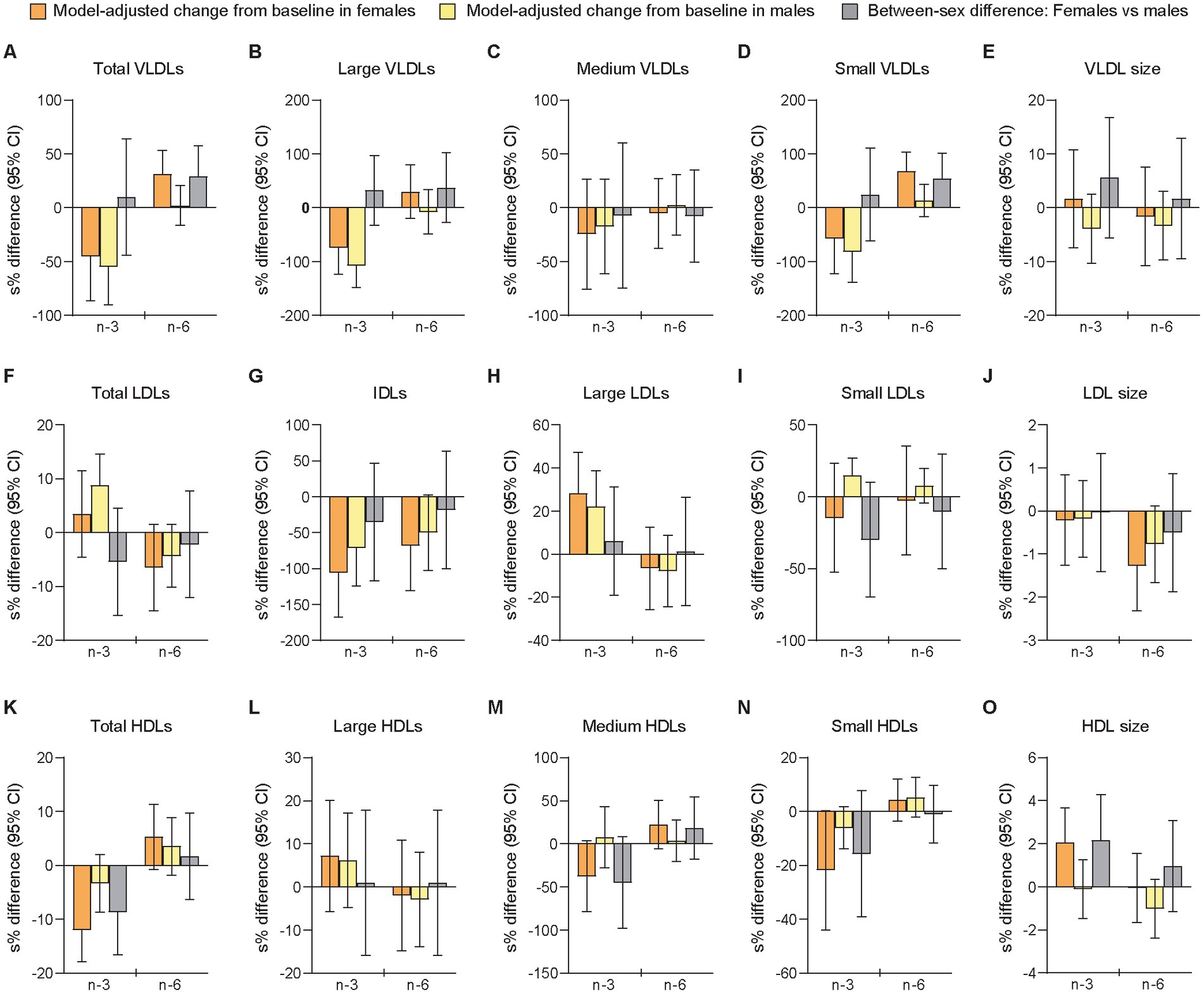


Figure 2. Differences between females and males in change scores for lipoprotein subfractions after 7 weeks of supplementation with n-3 or n-6 PUFAs. The bar plots show relative changes from baseline to follow-up and between-sex differences in change scores of particle concentrations and mean sizes for VLDLs (A-E), LDLs (F-J), and HDLs (K-O). VLDLs and LDLs were measured in nmol/L, HDLs in μmol/L, and particle sizes in nm. Data were analyzed with period- and baseline-adjusted cLMMs (see main text). Before the analysis, values were transformed by the natural logarithm and multiplied by 100 to show within-sex changes and between-sex differences as additive, symmetric percentages (sympercents; see main text). Error bars represent 95% CIs. Relative changes from baseline to follow-up within females and males are shown in orange and yellow bars, respectively. Between-sex differences in relative change scores are shown in gray bars. Number of participants included: n = 39 (16 females, 23 males) at baseline in P1; n = 38 (16 females, 22 males) at follow-up in P1; n = 38 at baseline in P2 (16 females, 22 males); n = 38 at follow-up in P2 (16 females, 22 males). cLMMs, constrained linear mixed-effects models; HDL, high-density lipoprotein particles; IDLs, intermediate-density lipoprotein particles; LDLs, low-density lipoprotein particles; n-3, omega-3 PUFAs; n-6, omega-6 PUFAs; PUFAs, polyunsaturated fatty acids; P1, the first intervention period; P2, the second intervention period; s%, sympercent; VLDLs, very-low-density lipoprotein particles. Total VLDLs and large VLDLs also include chylomicrons if present.


Wednesday, 7 April 2021

Effects of a Mediterranean Diet, Dairy, and Meat Products on Different Phenotypes of Dyslipidemia: A Preliminary Retrospective Analysis


Background: Dyslipidemia is one of the major causes of atherosclerotic cardiovascular disease (ASCVD) and a Mediterranean Diet (MD) is recommended for its prevention. The objectives of this study were to evaluate adherence to an MD at baseline and follow-up, in a cohort of dyslipidemic patients, and to evaluate how different food intakes can influence lipid profile, especially how different sources of saturated fatty acids impact lipid phenotype. 

Methods: A retrospective analysis was conducted on 106 dyslipidemic patients. Clinical characteristics, lipid profile, and food habits data were collected at baseline and after three months of follow-up with counseling. Adherence to an MD was evaluated with a validated food-frequency questionnaire (MEDI-LITE score). 

Results: The cross-sectional analysis showed that higher consumption of dairy products correlated independently with higher levels of total cholesterol (TC), high-density lipoprotein cholesterol (HDL-C), and low-density lipoprotein cholesterol (LDL-C) and with lower triglycerides (TG) levels. Instead, lower HDL-C and TG levels and higher TC levels were independently associated with higher consumption of meat products. Adherence to an MD significantly improved after the follow-up period, from a mean value of 10 ± 3 (median 10, IQR 8–12) to 13 ± 2 (median 14, IQR 12–15), p < 0.0001. 

Conclusions: Dyslipidemic patients benefit from counseling for improving their adherence to an MD. The high intake of dairy products was associated with less atherogenic hyperlipidemia, which was characterized by higher levels of TC and HDL-C as compared withs the intake of an excessive amount of meat products, which was associated with higher levels of TC and TG and lower levels of HDL-C.

the full paper is here.