Lifestyle changes can improve the course of Parkinson’s disease, according to research.
to continue reading, this is the link.
Lifestyle changes can improve the course of Parkinson’s disease, according to research.
to continue reading, this is the link.
γράφω ως Αριστερό Εξτρέμ
Σήμερα οι νευροεκφυλιστικές ασθένειες αυξάνονται με αλματώδη ρυθμό! https://www.alzint.org/about/dementia-facts-figures/dementia-statistics
Κάθε 3 δευτερόλεπτα, ένας άνθρωπος αναπτύσσει άνοια. Το 2020, υπήρχαν 55 εκατομμύρια με άνοια στον κόσμο. Το 2020, έχασα τον πατέρα μου από Parkinson’s και άνοια. Είναι τραγικό να βλέπεις τον άνθρωπό σου να έχει μαρτυρικό θάνατο. Και να μην μπορείς να κάνεις κάτι…
Πάντα πίστευα ότι το Parkinson’s σχετίζεται με την μοναξιά, αλλά δεν μπορούσα να το αποδείξω. Ο μπαμπάς ήταν μοναχικός..
Σήμερα, όμως το ξέρουμε ότι η μοναξιά συνδέεται με το Parkinson’s. https://www.parkinsons.org.uk/news/loneliness-linked-increased-risk-developing-parkinsons
Από την χρονιά που διαγνώσθηκε ο πατέρας μου (2013), έχω αρχίσει να μελετώ οτιδήποτε έχει σχέση με τις νευροεκφυλιστικές ασθένειες. Και η έρευνά μου στο UL έχει πάει και προς αυτόν τον τομέα:
The Role of Dietary Lipids in Cognitive Health: Implications for Neurodegenerative Disease
https://www.mdpi.com/2227-9059/10/12/3250
Πριν από λίγες μέρες διάβασα αυτήν την είδηση στους Times του Λονδίνου:
Το άρθρο αυτό γράφει
“Patients suffering with early Alzheimer’s disease are feeling hopeful that a recent breakthrough in “game-changing” medicine to treat the illness will increase their lifespan and slow down decline.
Lecanemab, which has been described as the first “credible” drug to treat the disease, was approved by the US Food and Drug Administration last year. It is being reviewed by the European Medicines Agency (EMA) and is expected to be approved by the end of this year”.
Έρχεται λοιπόν ένα φάρμακο με το όνομα Lecanemab για το Alzheimer. Για να δούμε…
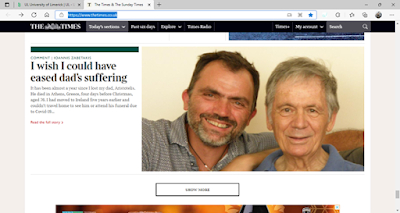
Source: The Times, 08.12.2021
It has been almost a year since I lost my dad, Aristotelis. He died in Athens, Greece, four days before Christmas, aged 76. I had moved to Ireland five years earlier and couldn’t travel home to see him or attend his funeral due to Covid-19 restrictions. Like Ireland, voluntary assistance in death is illegal in Greece. If it was permitted in Ireland I would have brought him here to die. In my mind, dad died when he became bedridden, 16 months before he took his last breath.
My dad studied chemistry and economics at the University of Athens and went on to work in the textile industry. In the later stages in his career, he researched how to make fabrics more UV-radiation protective, the system for rating clothes now known as the Ultraviolet Protection Factor.
Dad inspired me in many ways. He taught me to be practical and always to look at the bigger picture. I owe to him my disposition for applied research, which led me to pursue a career in academia.
Dad was diagnosed with Parkinson’s in 2013. We knew what was coming; we knew that at some point he would not be able to eat, to move, to breathe. The summer of 2018 was the last time I was able to spend quality time with him. By the following year dad couldn’t walk down the stairs of his second storey apartment. It was a downward spiral from there.
By September 2019 dad was bedridden and cared for full time by a live-in nurse. He couldn’t swallow. His medicine was crushed up and delivered with his food through a stomach peg. He had a catheter and wore a nappy. On the good days he could say one or two words, or smile.
On New Year’s Day last year I showed dad photos of the fireworks in Limerick. He said: “Wow, this is impressive.” The next day he couldn’t speak. Soon after, there was no communication at all. I could still hug him, hold his hands and talk to him, although I do not know if he could understand me. He couldn’t express himself, he couldn’t tell us how he felt.
It was very hard, especially in the last four months as dad’s oxygen levels were dropping. We couldn’t do anything; we could only watch him die slowly. If I could have eased his suffering earlier I would have. He had a long fight and there was no quality of life for him. When he passed away it was a relief — for him from the suffering and for us watching him die. It wasn’t a decent death.
We need to show more empathy to people who have terminal or degenerative illnesses. We need to have legislation in place so that people can make the choice to die with dignity. I’m not sure if my dad would have chosen medical assistance to die, but I think everyone should have the right to choose.
Dad loved travelling, dancing and soccer. When he retired, he moved to the village of Styra in Southern Evia where he joined a local dance society that he would attend three times a week. Every summer he would dance in the local festival.
When I travel with my sons or we watch soccer matches together, I feel closer to dad. These are the things we shared in the good days. That’s how I try to remember him. Not the way that he died.
Dr Ioannis Zabetakis, head of the biological sciences department at the University of Limerick, backs the Times and Sunday Times campaign to legalise assisted dying
