Showing posts with label agriculture. Show all posts

Sunday, 28 March 2021

Greenouse gases, methane and the ...cows


Will Ireland sacrifice its sacred cows to meet climate change targets?

‘No country has ever set such an ambitious target,” said Green Party leader Eamon Ryan, when describing the short-term goal of halving emissions by the end of this decade at the launch of the Climate Action and Low Carbon Development (Amendment) Bill 2021 last week. The bill’s long-term goal is no less ambitious. By 2050, it wants Ireland to reach net-zero emissions — producing no more CO2 than is removed from the atmosphere through sequestration measures such as planting trees. This is also “a challenge beyond compare”, Ryan said.

Micheál Martin, the taoiseach, argued that the “hardwiring into law” of sectoral emissions targets, which means that the government could be taken to court if it failed to meet them, would fundamentally alter Ireland’s response to the climate crisis by “forcing change”.

(...)

The big political sticking point when it comes to reducing emissions in Ireland has been agriculture. It accounts for 35 per cent of emissions, more than any other sector. Farmers have long argued that they are a special case, on the basis that it is harder for them to reduce emissions than it is for other sectors, and that any reduction in beef or dairy production here will simply be displaced to other countries, probably in South America, which may be less environmentally responsible.


= = = 

Let’s discuss Joseph Poore and Nemecek’s study as it is regularly referenced.

Let’s review some of these issues...

•Animal agriculture unfairly gets corn and soy agricultural GHGs added to their LCAs. Corn and soy are grown for human use first. We’re LUCKY that cows will turn our waste into nutrient dense foods.

•The study doesn’t take into account water footprint. 

•And then, for emissions, the gases lifecycle isn’t taken into account.

Another glaring issue is that the study is based on conventionalagriculture. No mention of regenerative agriculture, holistic planned grazing, or agroforestry. 

In the end, “sustainability” will depend on what variable you are optimizing—is it greenhouse gas? Land use? Acidification? Animal welfare? Productivity? They don’t always point in the same direction.

Let’s go over the bullet points in more detail.

Feed:
Cattle feed on 90-100% grass/ alfalfa/ hay. The grain they do consume is by-product after human use (for instance high fructose corn syrup, ethanol, corn meal etc and soy oil). Whole grain can be expensive to feed. They do get whole grains though especially during finishing which is usually grains that were deemed unfit for human consumption. Then there is also silage which is the whole plant all chopped up.

Water Footprint:
First of all not all water is equal. 

So really it isn’t about total water but what kind of water.

The water that pastured animals get is almost entirely green water. It falls as rain. It’s not blue water that is pumped to them. All animals can be pastured. 

* One main difference among all methods for assessing water use is whether and how they include green and gray water. The “water footprint” approach includes green water, whereas life cycle assessment approaches tend to exclude green water or to include only the variation in green water resulting from changes in land use. A second difference is whether water use is reported as a volume of water or as an index of water-use impact (e.g., H2O equivalents). A third is whether water that returns to the same location (e.g., in urine) is considered to have been consumed.


* Because of these differences and the fact that existing studies have analyzed only a limited number of different livestock production systems, methods give wildly different results for the same livestock product. For example, estimations of water use to produce 1 kg of beef range from 3 to 540 L of H2O or H2O equivalents for the life cycle assessment approach and from 10,000 to 200,000 L of H2O for the water footprint.

GHGs and their lifecycle.

First of all the largest AGRICULTURAL contributor to GHG emissions is PLOWING, not cattle.

"We can't eat our way out of climate change...U.S. beef has one of the lowest carbon footprints in the world, 10 to 50 times lower than some nations. Greenhouse gas emissions (GHG) from cattle only account for 2-3% of U.S. GHG emissions. For comparison, landfills contribute 2.2%; 27% comes from transportation; 27% from electricity; and 40.9% from other sources."

One of the biggest concepts being missed in our push to reduce “emissions” is that cattle are actually part of the carbon cycle, while extracting fossil fuels are introducing NEW greenhouse gasses to the environment.

Methane:
There is an old fake-science idea doing the rounds again at the moment. This is that cows are culprits in the global warming narrative. The problem, however, is that the scary image of cows destroying the planet with their carbon emissions doesn’t fit with how the planet actually works.

No cow alive today, nor any cow that has ever existed, nor any cow that will ever exist, can add a single atom of carbon to the atmosphere that wasn’t already there in the first place.

At one point of the carbon cycle, it is true that cows emit carbon dioxide (CO2) and methane (CH4) to the atmosphere, each of which contains one atom of carbon. This is a basic fact of biology – but what about some other basic facts to go with it?

It would seem the fact that ruminants emit carbon gases is regarded as the clincher argument by people like Rosemary Stanton and Kris Barnden, who recently published an article on the ABC News website damning cattle. The problem is they fail to put this isolated fact together with others to give it context and, in this way, create a misleading impression. They fail to describe how a cow exists within the carbon cycle. They fail to ask a fundamental question; ‘Is the carbon a cow emits new carbon to the atmosphere?’

The believer/activists don’t explain that cows eat plants and that all the carbon in a plant comes from the atmosphere, not the ground. The carbon in the leaves comes from the minute traces of carbon dioxide in the air around them via the process of photosynthesis. Even the carbon in the roots of plants comes from the atmosphere and even the carbon in the carbohydrate sugars that the roots exude to soil microbes in a swap for nutrients, comes from the air above us. The energy for this is captured by the plant’s own solar panels – its leaves.

The believer/activists don’t explain that when a cow eats a plant it is vicariously ‘eating’ carbon from the atmosphere. They don’t explain that, when that cow exhales carbon dioxide or belches methane, the carbon in those gases goes back to where it ultimately came from – the air around them.

The implications of photosynthesis are not divulged to the public by the cows-are-culprits believer/activists. They don’t explain where animals get their energy from and how their food sources become laden with energy. (Hint: it’s ultimately from the Sun and it involves the carbon cycle, the water cycle and photosynthesis.)

Plants combine carbon, hydrogen and oxygen to make carbohydrate chains or ‘sugars’. (C6H12O6)

Cows and other animals consume these carbohydrate sugars and ‘burn’ them as energy to run their bodies. As a result of this ‘combustion’ the by-product of carbon dioxide is produced and exhaled to the atmosphere. We humans do the same thing. Once in the atmosphere, the carbon dioxide again becomes available for photosynthesis in plants, and so the cycle starts over again. This is an example of sustainability in plants and animals.

So, with regard to the carbon dioxide the cow breathes out, it goes straight back to where it came from – the atmosphere.

What about the methane?

The methane issue is a kind of blind spot for those who vilify cows because most bovine critics would see themselves as deeply concerned about preserving a natural and organic environment. Well, methane from cattle is a natural and organic gas but the detractors portray it as something else – something unusual, something particularly sinister. Methane production is also solar powered – another appealing feature to those concerned about natural and organic things. Methane inevitably results from the process of plant growth (photosynthesis) and subsequent fermentation by various agencies such as microbes, insects and ruminant animals. Methane occurs naturally and abundantly in rainforests, wetlands, lakes, swamps, rivers and arid zones.

Methane is produced naturally and organically in the environment by microbes, ruminant animals, wild grazing herds and the prodigious activity of insects such as ants and termites.

A cow has a part of its digestive process that we do not have and this enables it to eat tough cellulose food. This fermentation chamber is called a rumen where, with the aid of microbes, the cow processes tough cellulose foods in the absence of oxygen. The by-product of this combustion is methane (CH4) which is then belched.

The methane molecule is oxidized within one decade and brakes down into CO2 and water. – see equation at end. For the period that the methane molecule is in the atmosphere it is a potential global warming gas but its molecular characteristics – its heat absorption capacity – is not well matched to the frequency at which the Earth radiates heat. For this reason the theoretical heat-trapping potential of methane is curtailed when the gas converts to its original form. And, in any case, it is a natural part of the environment that has been happening for hundreds of millions of years by vast herds of ruminant herbivores across the globe.

It seems that the detractors of cattle are reluctant to concede that the emissions of cows are part of a closed and self-completing carbon cycle in the atmosphere. This organic cycle involves all plants and animals, including ourselves.

In conclusion, the carbon gas emissions of cows are just one point in a giant circle that is the atmospheric carbon cycle. If you plot the other points in the cycle, it forms a giant circle which loops back to the start point. There is no new carbon in the atmosphere as a result of a cow’s existence.

Some relevant equations

Photosynthesis.

The general equation for photosynthesis is:
6CO2 + 6H2O + Sunlight absorbed = C6H12O6 + 6O2

Note: The C6H12O6 molecule is a carbohydrate molecule – a food ‘sugar’ which can be eaten by an animal and ‘burnt’ to produce energy. When this molecule is ‘burnt’ it produces carbon dioxide (CO2) as a by-product. This is then exhaled to the atmosphere as the same gas as it was prior to the growth of the plant the cow eventually eats.

The Breakdown of methane.

Conversion of methane to carbon dioxide and water is:
CH4 + 2O2 = CO2+ 2H2O + Energy (Heat given off)

Also, when methane is measured from cows, it's done via "gas chambers" or enclosed systems where only the methane that the bovine burps out is measured. It's often never measured in an ecological context, where methanotrophic bacteria are available at the soil surface to oxidize the methane that the ruminants burp out. 

While this is explained pretty well for the layman, another thing that wasn't mentioned was the role of hydroxyl radicals (OH compounds) that also act to oxidize methane. Hydroxyl radical comes from when oxygen reacts to UV light and frees up an oxygen atom; that oxygen atom binds with a hydrogen atom that came from water vapour creating the OH radical, which binds to CH4 to oxidize it, rendering it unstable. These hydroxyls often come from the water vapour put off by transpiration of plants. And of course, the greater the green cover there is (the greater number of green photosynthetic solar panels there are), the more water vapour and oxygen is given off, the greater the efficacy of these natural atmospheric compounds have to oxidize methane. 


Thursday, 18 March 2021

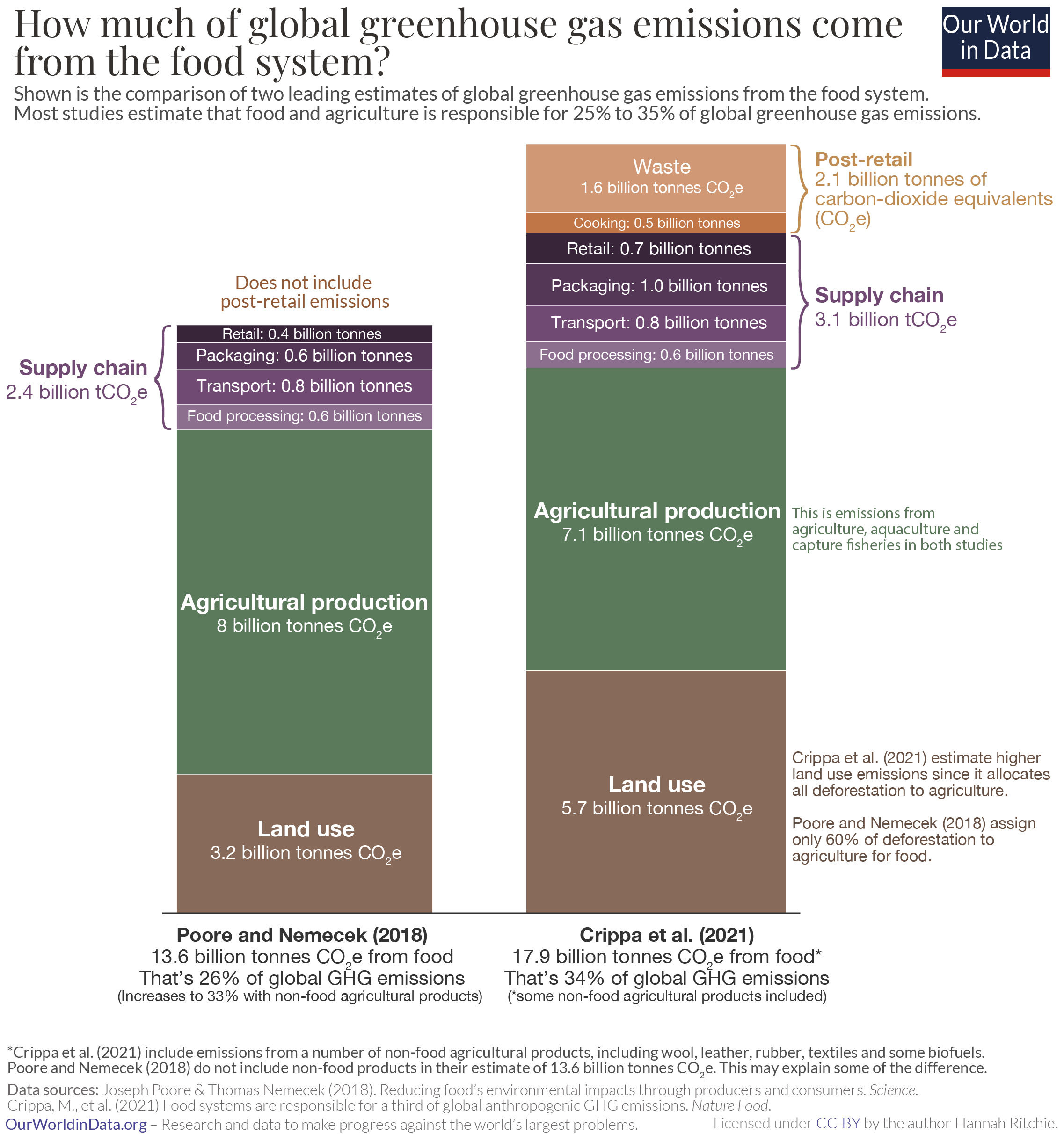
How much of global greenhouse gas emissions come from food?


 source: How much of global greenhouse gas emissions come from food?

Summary

There are a wide range of estimates for how much of the world’s total greenhouse gas emissions come from food. Some studies say this figure is one-quarter, some say it’s more than one-third.

Where do these differences come from? There are three reasons why some of these estimates vary so much:
1) some studies do not include emissions from cooking and food waste;
2) different studies disagree about the emissions from land use change and deforestation; 
3) some, but not all, studies include non-food agricultural products such as cotton, wool, leather and biofuels

The specific number that answers this question depends on these three factors, but the range of possible answers is not too large: around 25% to 30% of global emissions come from our food systems, and this rises to around one-third when we include all agricultural products.


One-quarter or one-third: how much of global emissions come from food?

It is nothing new that estimates of food emissions span a wide spectrum. The Intergovernmental Panel on Climate Change (IPCC) Special Report on Climate Change and Land reports a range from 10.8 and 19.1 billion tonnes of CO2-equivalent (CO2e) emissions per year. That’s between 21% to 37% of global total emissions. Quite a big difference. We’ll soon see where these disagreements come from.

In light of this, the difference in estimates from Poore and Nemecek (2018) of one-quarter, and Crippa et al. (2021) of one-third are not that surprising. They fall right in the middle of this wide range. Given that they are using very different  methods to get to these numbers it is actually encouraging, from a research perspective, that these estimates are so close to each other. But we should still try to figure out where the differences come from.

In the chart here I’ve shown the results of these two studies side-by-side. I’ve grouped emissions into their comparable parts of the food chain:

  • Land use: this includes deforestation, peatland degradation and fires, and emissions from cultivated soils.
  • Agricultural production: this includes emissions from synthetic fertilizers (and the energy used to manufacture them); manure; methane emissions from livestock and rice; aquaculture; and fuel use from on-farm machinery.
  • Supply chain: this includes all emissions from food processing, packaging, transport, and retail, such as refrigeration.
  • Post-retail: this is all the energy used by consumers for food preparation, such as refrigeration and cooking at home. It also includes emissions from consumer food waste.

Poore and Nemecek, shown on the left, estimated that food was responsible for 13.6 billion tonnes of CO2e. Crippa et al. estimate 17.9 billion tonnes of CO2e. So, there’s a difference of around 4 billion tonnes. Where does it come from?

  • Consumer cooking and waste are not always included in Poore and Nemecek: the easiest differrence to spot is that Poore and Nemecek only quantify emissions up to the retail stage of the supply chain. They don’t include energy use by consumers or consumer waste. As we see from the chart, this amounts to 2.1 billion tonnes CO2e.
  • Land use emission estimates differ: the biggest difference is in land use emissions. Crippa et al. (2021) estimate emissions to be 2.5 billion tonnes CO2e higher. This can be largely explained by differences in the attribution of deforestation. They allocate all of global deforestation to agriculture. However, the authors note that this is a main limitation of their approach, since only around 80% of deforestation is driven by agricultural expansion (the rest driven by urban development, mining and other human land use change). So their deforestation estimate is possibly a bit too high. Poore and Nemecek only allocated 60% of deforestation to food systems. This might be a bit of an underestimate. Land use emissions due to agriculture are likely to be somewhere in the middle of these two values.
  • Food vs. non-food agricultural products: the other main difference is that Poore and Nemecek only include food products in their 13.6 billion tonnes CO2e figure. Non-food agricultural products such as cotton, wool, leather, rubber and biofuels are not included. They do also provide a separate estimate which includes non-food products; this estimates that agricultural products as a whole contributes 33% to global emissions. Crippa et al. (2021) do include at least some of these non-food agricultural products in their estimate.

Comparing these two studies is useful because they highlight the main differences we see across the range of studies on food emissions. The big differences are: what stages of the supply chain are covered (some studies include consumer cooking and waste, some don’t); whether non-food agricultural products such as biofuels and textiles are included; and the biggest uncertainty is emissions from deforestation and land use change. The uncertainty in deforestation emissions estimates from the UN FAO can be as high as 50%, and over 100% for emissions from peatlands. Deforestation can also vary a lot from year-to-year, so decadal average values are often used.

How much of global greenhouse gas emissions come from food systems? The amount of uncertainty in these estimates means it’s helpful to understand where the differences come from, and that they all fall within a reasonably narrow range. If someone asks me, my response is usually “around 25% to 30% from food. Around one-third if we include all agricultural products.”


the agri-food sector and climate science indicators

 source: Irish Times


On the morning of February 25th, Karen Ciesielski, co-ordinator of the Environmental Pillar (EP), joined a virtual meeting of the Department of Agriculture’s Agri-Food 2030 Committee. The committee members had spent 15 months working on a Government strategy that will profoundly reshape the Irish landscape, farmers’ lives and our food system, and a draft version had been circulated a few weeks before.

The EP coalition were dismayed at what they read. They believed it did not put livelihoods, a fair price for producers and environmental considerations to the fore. After submitting lengthy proposals on multiple occasions, including targets for legal compliance, Ciesielski told the committee, which is headed by agricultural economist Tom Arnold, they couldn’t support it. They were out.

“We felt strongly we should be at the table and we stayed engaged throughout the process,” she says. “The decision wasn’t easy, but how can we campaign for the environment and sustainable agriculture and sign something that is so against what we believe in? It’s full of lofty language about sustainability but the actions aren’t there.”

In 2019 the publicly-funded EP, comprising 33 non-governmental organisations (NGOs), was offered a seat on the 30-person committee by the department. It had requested two more seats for Stop Climate Chaos (whose members include Trócaire, Concern and Irish Doctors for the Environment) and the Sustainable Water Network (an umbrella group of 24 NGOs); this was rejected and Ciesielski was asked to represent them all.

Committee members selected by the department include five business lobbyists, five farm organisations, one fishing representative, one banker, chief executives of companies, including Glanbia and Keelings, chairs of State agencies, including the Environmental Protection Agency, and scientists and academics (one of whom also works for an agri-feed company).

The predecessors to Agri-Food 2030 were economically ambitious. Food Harvest 2020 had specific production targets that were achieved within years; Food Wise 2025 continued along the same vein. Both strategies have brought significant economic growth; in the last decade, food and drink exports doubled in value to €14.5 billion.


Increased emissions

It has come at a price to the environment, however. Nitrogen and greenhouse-gas emissions have increased beyond legal limits and scientists point to the expansion of agriculture, under these strategies, as a driver of water pollution. About 85 per cent of protected habitats have “unfavourable” status and the National Parks and Wildlife Service says the main reason for the decline is agricultural practices. Species are slipping away; scientists warn we’re facing a “silent spring” with a loss of bees and point to intensification as a reason for this.

“We’ve been very slow to act,” says Dr James Moran, an agri-environment expert from the Institute of Technology Sligo who sits on the “Cap 4 Nature” group of independent scientists. “I hope this strategy has clear targets and measurements for success for the environment. If we don’t make serious changes now, in 10 years’ time we’ll be in for a big shock with serious consequences for farmers and industry, with very heavy and painful cuts.”

The EP’s decision to stand down attracted damning criticism from the agri-media, with claims they’re driven by “deep rooted ideology” and a sense of moral superiority. It was met with disappointment from committee members, some of whom agreed with aspects of what the EP had asked for, but felt it was a mistake to withdraw before the final document was agreed.

President of the Irish Farmers’ Association, Tim Cullinan, who sits on the committee, was surprised. “I’d much prefer that the EP would have continued,” he says, adding that while the two previous strategies were about growth, Agri-Food 2030 would “point us in a different direction of travel. We have to be carbon neutral by 2050. We’re all striving to get there.”

It comes at a critical time for food policies. Ireland’s Climate Action Bill will set out how emissions will be reduced for the next decade. Internationally, the goal of carbon neutrality by 2050 will form the backdrop to two major United Nations summits this year: the Food Systems Summit and the COP26 Climate Change conference.

There are seismic shifts at European Union level, along with Common Agricultural Policy reform. The European Green Deal, with the Farm to Fork strategy and the €20 billion biodiversity strategy, will feed into the need for food policies that are fair, healthy and environmentally friendly.

Opportunities

This offers momentous economic opportunities and the Agri-Food 2030 strategy seeks to position Ireland as an international leader in “sustainable food systems”. Does the data back that up? According to economist Alan Matthews, professor of EU agricultural policy at Trinity College, the trends in emissions, water and biodiversity mean that Irish agriculture is not on a sustainable path.

Intensification of dairy farming is a key – but emotive – issue. In the past decade, dairy farm incomes have increased by about 31 per cent and although farmers are carrying debt and working hard, dairying is an economically viable way to stay on the land. The dairy processing sector has significantly grown andsells nearly all of its output worldwide. The herd is forecast to grow by 200,000 between now and 2027, bringing the total to 1.65 million cows.

Some farmers are rapidly pivoting towards ecological-friendly farming. But an increased dairy herd will mean we’ll all pay an ecological price. “We’ve seen declines in water quality that are clearly linked to dairy intensification, particularly in the south and southeast,” says Sinead O’Brien of Sustainable Water Network.

“It’s unlawful under the EU’s Water Framework Directive and the Nitrates Directive. If this strategy goes ahead we’ll see bigger dairy farms, hedgerows going, wetlands drained, scrub being cleared. We’re in an absolute crisis of nature loss, climate change and plummeting water quality. The strategy is completely divorced from the scientific reality.”

Beef and tillage farmers are also concerned that their livelihoods will be shut out. “Where will this expansion finish? Will we have to milk a thousand cows?” says farmer Edmond Phelan, who sits on the committee as a representative of the Irish Cattle and Sheep Farmers’ Association. “We have to get away from the idea we have to just keep expanding. It can’t just be about output, uber alles.”


One of Ireland’s leading climate scientists, Prof John Sweeney, says it makes good economic sense to act now. “I would like to see a change in direction from a policy of intensification towards diversification that encourages the family farm. What I worry about is the sense that once we lose our clean green image and the world cottons on to the cost of production to the Irish environment, then the risk to agriculture will increase substantially.”

Shared interests

This points to an increasing alignment of shared interests between some farmers, scientists and environmentalists, who are together wondering: who should benefit from these policies? And where does it leave small to medium-sized family farms?

In the draft Agri-Food strategy, it says that the number of farmers earning their living exclusively from farming “is likely to continue to fall during the next decade”. The acceptance of this as a fait accompli is not only of concern to Edmond Phelan.

“What worried me most is that smaller farmers are being abandoned,” says Oonagh Duggan of BirdWatch Ireland, an EP member. “I see nothing in this to support these farmers . The ambition is very low. If we don’t see ambition now – when will we see it?”

The strategy is due to be finalised and sent for public consultation within weeks. The withdrawal of the EP has undoubtedly heaped pressure on the remaining committee members; as signatories to this strategy, they will have to stand over and defend their decision in the future. The stakes could not be higher.


Monday, 4 May 2020

let's talk about agricultural emissions


Politicians do not like hot potatoes. For many reasons. The main one is this: the data are complicated and most politicians are not experts of their field. Nothing wrong with that. But they can seek advice before they commit to policies. Because at the end of the political day, policies should be based on science.

One of this hot potatoes today in Ireland is the "sacred cows": agricultural emissions and the food chain. The main gases that are emitted from cattle are carbon dioxide, nitrous oxide and methane.

Greenhouse gas emissions are commonly presented in units of billion tonnes of carbon dioxide equivalent (Gt CO2e). The de facto way of converting non-CO2 emissions to CO2e is to multiply the gas by its GWP100 (global warming potential over 100 years). The value of GWP100 for methane (CH4) from the last IPCC assessment report is 28. This means that methane has 28 times as much “global warming potential” as CO2, so 1Gt CH4 equates to 28 GtCO2e.

However, there is a problem here: CH4 has a half-life of 10 years, ie after ten years, only half of CH4 still exists; after 20 years, only a quarter. This complicates the calculations slightly but as I said at the top, good Science can always help.

Or as Prof Mitloehner explains: 
"The so called biogenic carbon cycle is continuous. In the case of biogenic methane, its carbon originates from atmospheric CO2, goes through plant photosynthesis, then enteric/manure methane, then via hydroxyl oxidation into CO2 again. This process takes approx one decade".  

Let's have a look now on the food side.  

The beef sector in Ireland is very significant accounting for over one-third of all agricultural output and over 20 percent of total Irish food and drink exports. The agri-food sector in general provides direct and indirect employment to over 300,000 people with over 13,000 employed in the meat processing sector alone. The value of beef exports is growing and exceeded €2.6 billion in 2017. Domestic consumption of Irish beef accounted for a further €230 million last year. In all, the value of the Irish beef sector is estimated to be almost €2.9 billion.

So, when we talk about reducing emissions, part of the discussion should be the impact of reducing emissions to farmers and meat industry. This is where it gets complicated and the stakes are rising.

Let me finish on a personal note: I started working on waste management and its impact on the food chain about 13 years ago in the case of Asopos. Poor waste management resulted to polluted water and cross-contaminated food chain with Ni and Cr.
In that case, the polluters should pollute less by investing in cleaner technologies. This, never happened in Asopos. Because the Greek State accepted that polluting (the water and the food chain) is less costly than reducing the chemical wastes.

The end point is this: Science and Technology offer the tools. Politicians need to use the tools wisely and transform the Society. If at the end of the day, we may have to reduce (let's say by 10%) the agricultural sector but at the same time provide subsidized retraining of affected people to newer, greener (not green-washing) technologies, let's consider it. Doing nothing can not be a solution.

IZ


P.S. Many thanks to Prof Frank Mitloehner for the literature.