Showing posts with label RTE Brainstorm. Show all posts

Friday, 5 March 2021

Why is there only one Irish cheese with protected status?

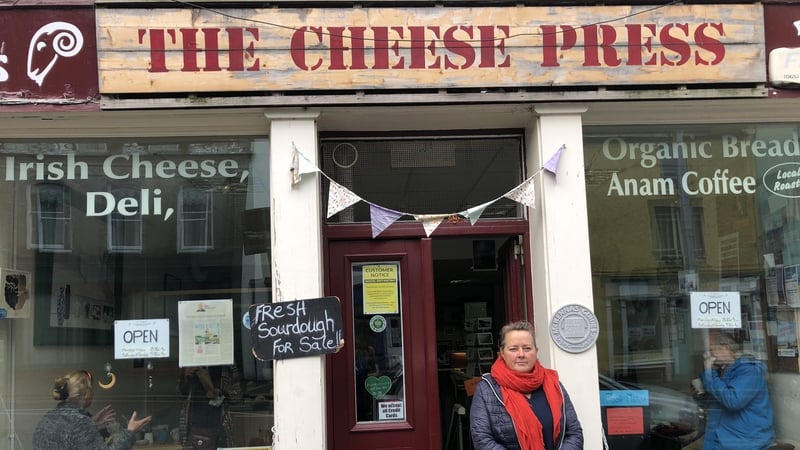
Chockablock with Irish cheeses: the Cheese Press in Ennistymon, Co Clare. Photo: Teresa Mannion


source: RTE Brainstorm


Opinion: the protected designation of origin scheme could be of huge commercial benefit to Irish cheese makers

Would it surprise you to learn that Ireland has only one protected designation of origin (PDO) cheese? By comparison with Ireland's only PDO cheese (the Imokilly Regato), Greece has 23 PDO cheeses. 

First of all, what's a PDO and why is it so important? PDO refers to a number of European Union schemes which promote and protect names of quality agricultural products and foodstuffs. Aside from the PDO scheme, there's also schemes for protected geographical indication and traditional specialities guaranteed.

All of these schemes aim to protect the reputation of the regional foods, promote rural and agricultural activity, help producers obtain a premium price for their authentic products and eliminate unfair competition and misleading of consumers by non-genuine products, which may be of inferior quality or of different flavour.

From RTÉ Radio 1's Countrywide, a discussion on the Protected Designation of Origin scheme for food

Products registered under these schemes may be marked with a special logo to help identify those products. The schemes are based on the legal framework provided by the EU Regulation No 1151/2012 of the European Parliament on quality schemes for agricultural products and foodstuffs.

The laws basically protect the names of wines, cheeses, hams, sausages, seafood, olives, olive oils, beers, balsamic vinegar, regional breads, fruits, raw meats and vegetables. Examples of PDO labelled foods are the Italian Gorgonzola and Parmigiano-Reggiano, the Greek feta and the French roquefort. 

So how does PDO status protect local producers? Take, for example, the Roquefort cheese. This blue cheese must be made from milk of a certain breed of sheep and matured in the natural caves near the town of Roquefort-sur-Soulzon in the Aveyron region of France, where it is colonised by the fungus Penicillium roqueforti that grows in these caves.

From Ile de France Cheese, the strict rules which define what can be called Roquefort cheese 

The system is similar to appellation systems used throughout Europe, such as the appellation d'origine contrôlée in France, the denominazione di origine controllata in Italy, the denominação de origem controlada in Portugal, the denumire de origine controlată system in Romania and the denominación de origen in Spain.

The cheese industry in Ireland has many unique characteristics. On one hand, we have the major players, big dairy companies that make mostly cheddar from cow's milk. Then, we have tens of small family business who make amazing cheeses in sensory terms. A PDO labelling would help these producers in promoting their cheeses nationally but also (and mainly) internationally.

My research team studies the cardioprotective properties of sheep and goat cheeses. These cheeses have strong bioactivities against platelet aggregation and the onset of atherosclerosis. We have screened a number of ovine (sheep) and caprine (goat) cheeses and all these cheeses have strong anti-thrombotic and anti-inflammatory properties.

From RTÉ Radio 1's Today show, chef Domini Kemp and food writer Catherine Cleary's guide to Irish cheese

Due to the Covid-19 pandemic, the hospitality sector has closed and small cheese companies have lost a huge part of their trade. Consumers now buy from home via online sales so small cheese businesses rely on having a good website and online strategy to boost their online sales. But they also need to differentiate themselves from other cheese players. The PDO labelling is a strong way to provide an unique selling point for these family businesses and the Government needs to help them to obtain such pedigree.

So why haven't Irish cheese producers sought PDO status for their products? Anecdotal evidence from cheese producers refers to the lengthy and laborious procedure to obtain PDO status. This must change. The Irish food board, Bord Bia, needs to create simpler procedures and support mechanisms for farmers who wish to apply for PDO status.

In today’s business environment where food exports to EU are so straightforward, the fact that Ireland has only one PDO cheese looks like we are shooting ourselves in the foot. Irish farmers produce unique cheeses with superb sensory properties that can easily compete on an European and international level, but PDO status is a must. The State needs to simplify the process and create dedicated teams of scientists to collaborate with farmers in order to boost PDO applications.


The views expressed here are those of the author and do not represent or reflect the views of RTÉ
Wednesday, 26 February 2020

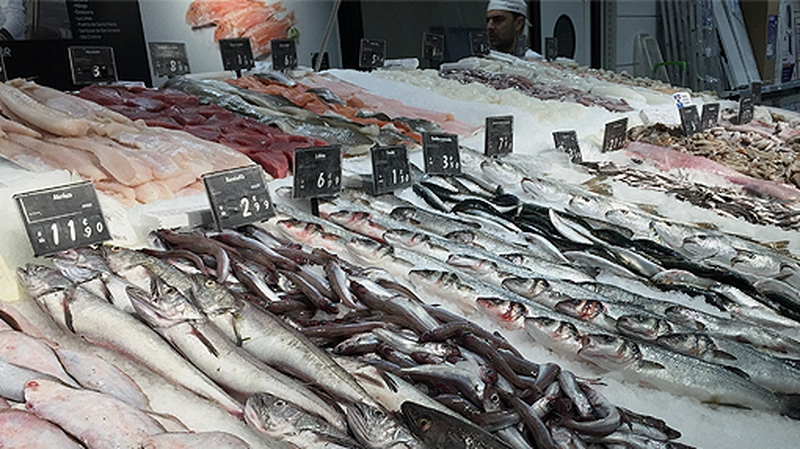
Why don't Irish people eat more fish?

"Fish is usually caught locally and the distance from the catching point to the retailer is usually not long"  

the full article with video extracts is here


Opinion: we need to develop ways to spread the message that fish is healthy, tasty and green

One of my hobbies is soccer training. After each session, I try to remind my young players the importance of exercise and a balanced diet. One day, I asked them "how many times per week do you eat fish?". One lad replied "do fish fingers count?". "Of course not" I wanted to tell him, but I said yes to him, as eating even that over-processed type of fish is better than nothing.
Let's have a look at the wider picture now. Ireland is an island, there are plenty of beautiful shores and beaches where people can walk by the sea, swim and …fish. Alas, the consumption of fish in Ireland is still low. Why is this?
Before moving to Ireland, my family and I lived in Greece, where we fished and snorkelled every summer. When the boys grew a bit older and could handle a fishing gun, a period of spear fishing started. Hunting for fish is an amazing experience. It makes you part of the sea, it encourages you to observe the sea creatures and view the world from a different angle. One of the messages I have tried to pass to the boys is that we have to eat what we catch so they started eating fish at a young age and developed a taste for it. Living now in Limerick, we are quite lucky and can find sea bream and sea bass from the Med, fish with pure sea flavour.

From RTÉ Radio 1's Mooney Goes Wild, why some fish are picky eaters

But the question remains: what is Ireland's problem with fish? In a comparison of fish consumption per capita in 158 countries in 2013, the Maldives ranked the highest with 166 kg followed by Iceland (90.1 kg) and Hong Kong (71 kg). Irish people consumed just 22.3 kg per capita. Fish consumption per capita in Ireland reached an all time high of 24.6 kg in 2001 and an all time low of 7.10 kg in 1961. When compared to Ireland's main peers, fish consumption per capita in Canada amounted to 22.4 kg, 34.7 kg in France, 90.1 kg in Iceland and 19.1 kg in United Kingdom in 2013. Ireland has been ranked 48th within the group of 160 countries in terms of fish consumption per capita, 4 places behind the position seen 10 years ago.
The comparison between Iceland and Ireland is striking because fish consumption is four times higher in Iceland. One may argue about the meat availability in Ireland at low prices, which is valid to some extent, but the reasons for the low fish consumption in Ireland are much deeper.
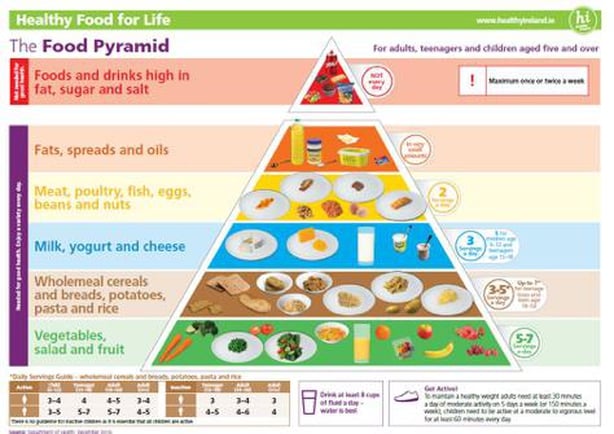
Part of the problem is the food pyramid which is taught to all secondary students in Ireland. In this pyramid, meat, poultry, fish, eggs, beans and nuts are grouped together. This grouping conveys the message that these foods have equivalent nutritional value. As we have explained before, this message is simply wrong.

From RTÉ 1's Prime Time, Richard Downes on how the Irish fishing industry is likely to be 
affected by Brexit


Last year, the author and others published a scientific paper titled "Changing the Irish dietary guidelines to incorporate the principles of the Mediterranean diet: proposing the MedÉire diet". We did so with the hope to challenge the current wrong dietary guidelines. Alas, nothing happened. The pyramid remained the same and it is still wrong.
The message conveyed is that eating fish is like eating meat and poultry. Despite all the scientific evidence that suggests that fish is an excellent source of anti-inflammatory and cardioprotective compounds and therefore fish is more nutritious than any type of meat, all meat and fish are grouped together. With poultry and fish on the same shelf in the pyramid, one may wonder "why would I spend at least €10/kg to buy fish when I can buy a 1.5kg chicken for €4-5?". Therefore, the dietary message turns to cost argument and then the fish case is lost.
So what can we do?

Modify the Irish food pyramid 

It is of paramount importance to correct the Irish food pyramid and give fish its correct place in the pyramid; highlighting the high nutritional value of fish and seafood is a matter of urgency. It is also important to differentiate fresh fish from processed fish products like breaded fish or fish fingers.
From RTÉ Learn, exploring Irish fish stocks

Educate young people 

The younger we start to educate children and young students the better. Today in Ireland, one in four boys and one in five girls are obese and it is crucial to address this problem. It is not easy, but it is doable. Everybody likes to have processed convenience food. Our taste buds have become used to these tastes and so real fish tastes exotic. We need to start exposing primary school students to healthy tastes. By "training" their taste buds, there is hope that they can develop healthy eating habits. The best way to educate young kids is through experiment and play - teaching them and cooking with them the food we eat can make a big difference.

Promote fish for all 

A variety of initiatives to promote could be organised in schools, universities, supermarkets and workplaces. Companies have a key role to play here as the health of employees and their families should be a top priority. You could have fish BBQs in the summer or food quizzes in rainy days. Ensuring that fresh fish is available as a choice would be a positive start.

Fish is a green food

We need to promote the fact that fish is a green food and much greener than meat. People are more aware about the food they eat, where it's sourced and how it's grown. Everybody wants to learn more about the origin of our food.
Fish is usually caught locally and the distance from the catching point to the retailer is usually not long. Of course, there is fish and seafood that are sold in EU and China, but we support can our economy and environment by choosing fresh Irish fish with very few food miles.
We need to encourage young people to develop the healthy habit of eating fresh (not processed) fish.
The feed conversion ratio (FCR) is an indicator that is commonly used in all types of farming which can provide a good indication of how efficient a feed or a feeding strategy can be. It's the mathematical relationship between the input of the feed that has been fed and the weight gain of a population. The lower the FCR, the higher the weight gain obtained from the feed. If FCR = 1, this means that we produce 1kg of a species with 1kg of feed.

When applied to aquatic animals, FCR is generally lower than that of land animals so we need less feed to produce the same amount of food. Fish do not require drinking water. Therefore, both the carbon and the water footprints of fish is superior to those of animals.
Average FCR
Omnivorous fish - 1.6
Farmed carnivorous marine - 1.45
Salmonids - 1.1
Pig - 2.75
Broiler (chicken) - 2.0
Beef cattle - 6.0
Dairy cattle - 8.0
Fish is healthy, tasty and green and we need to develop ways to spread across this message and encourage young people to develop the healthy habit of eating fresh (not processed) fish.

The views expressed here are those of the author and do not represent or reflect the views of RTÉ

Wednesday, 5 September 2018

Should we be concerned about glyphosate and GM foods?


my latest article on RTE Brainstorm on GMOs, Monsanto and glyphosate... But also cancer, politics and our gardens...

Should we be concerned about glyphosate and GM foods?

You can read more on Roundup at this fascinating book


Whitewash: The Story of a Weed Killer, Cancer, and the Corruption of Science 1st Edition


Next week in UL, it is week 1 and I am going to have with my Food Science and Health students  an extended literature search and debate over the next 12 weeks on the politics and the science behind Roundup. Their essays and presentations are going to be posted here.

Stay tuned :)

Ioannis Zabetakis


Sunday, 5 August 2018

Can yogurts and cheese reduce risk of heart disease?

Enjoy your full-fat fermented dairy


[our latest article on RTE Brainstorm]

Can yogurts and cheese reduce risk of heart disease?

Analysis: new research shows that increased consumption of fermented dairy foods is associated with reduced risk of cardiovascular diseases
By Ronan Lordan and Ioannis Zabetakis, University of Limerick

Cardiovascular diseases (CVDs) are a leading cause of mortality worldwide and 10,000 people die of CVDs in Ireland alone every year. There is a clear scientific and societal need to improve people’s health with specific focus on CVDs and offer healthy foods to the wider public. Hence, our research group’s interest on the cardioprotective properties of fermented dairy products. We want to understand what happens during milk fermentation and why and how fermented dairy is good for our hearts.

[full article is here]

Thursday, 28 June 2018

Why inflammation rather than cholesterol causes chronic disease

here is our latest article in RTE Brainstorm

Why inflammation rather than cholesterol causes chronic disease

4 points to remember: 

1.Mediterranean Diet 


2. walk/run/cycle/swim 

3. forget statins and 

4. try this test 

This test calculates your life expectancy and how long you'll stay healthy. We send you personalized recommendations for getting the most good years out of life. We keep your submissions and results private. 


= = =
 
Enjoy the Sun and don't forget to...
make your grocer your pharmacist (every day)!

"It is now well established that healthy dietary patterns, such as the Mediterranean diet, are associated with reduced risk of various chronic diseases by reducing inflammation towards homeostasis" Photo: iStock
 

Friday, 9 March 2018

Here's why the food pyramid is wrong

[from RTE Brainstorm]


Department of Biological Sciences

Opinion: we rely on the food pyramid to tell us what food to eat and how often, yet such dietary guidelines are not quite as straightforward as they appear

When it comes to nutrition, we rely on dietary guidelines provided often in a form of a pyramid. The current food pyramid in Ireland was published in December 2016. When such a pyramid is projected on a piece of paper (or a screen) it looks like a triangle with several shelves. The lower the shelf a food occupies, the healthier this food is and therefore the more often it must be consumed. Therefore, we can get a general guideline on what to eat and how often by looking at the pyramid. This is widely available and is also taught in all secondary schools around the country.


Alas it is wrong! And this is why…

The concept of food pyramids stemmed from the pioneering Seven Countries Study that was inspired by Ancel Keys in the 1950s and was carried out in the 1960s, 1970s and 1980s. Keys' research collaborators around the world screened the diet, the levels of serum cholesterol and the incidents of heart disease in different populations around the world. They found a clear linear relationship between serum cholesterol and heart disease in countries like US, Finland and Netherlands. The higher the cholesterol in the blood, the more fatal heart incidents were observed.

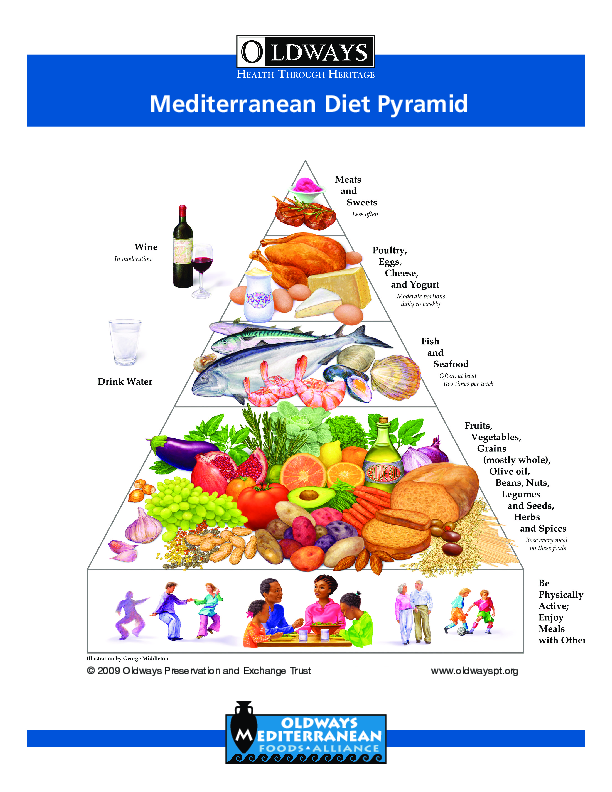
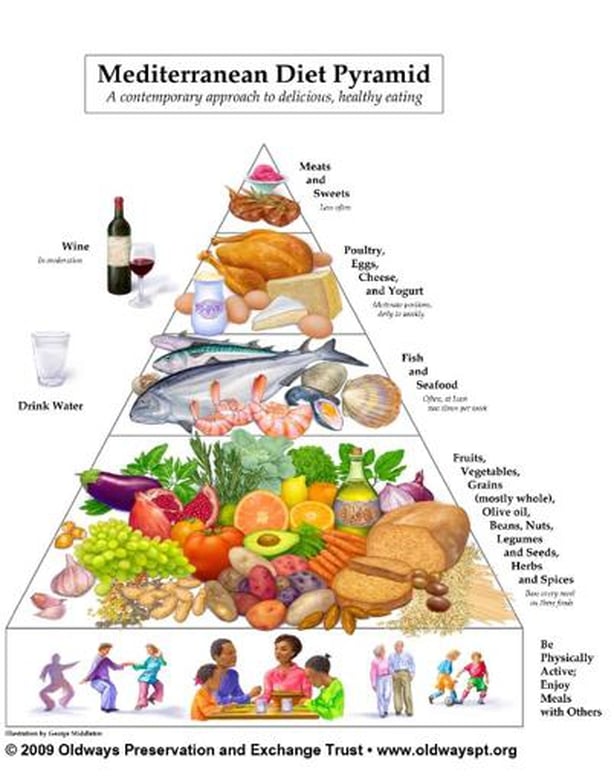
However, no such correlation was found in countries like Greece, Italy and Japan, i.e. blood cholesterol did not have an impact on heart-related deaths. There observations were used in order to design the Mediterranean Diet Pyramid by combing all the dietary habits in these countries. The message of this pyramid is that this diet has a cardioprotective effect and cholesterol does not cause heart diseases. Here's the current version of the Mediterranean diet pyramid

Comparing the two pyramids, we can observe that:
(1) in the Food Pyramid, both fats and oils and meat and fish are grouped together. From a food chemistry and nutritional point of view, these are major scientific mistakes.
(2) the cardioprotective properties of fats differ dramatically between processed fats (e.g. crisps) and natural fats (e.g. nuts, dried fruits, olive oil). The information that passes to the public is that all fats are the same, but this is not the case. We should communicate that some fats actually have strong cardioprotective properties (i.e. all polar lipids in wine, fish, vegetable oils, olives etc).
(3) meat and fish have distinctive nutritional values in terms of cardioprotection so it is a major oversight to group these foods. Fish (any fish) has strong anti-inflammatory properties and this is why fish have their own shelf in the Mediterranean Diet Pyramid.
We suggest that the Irish Food Pyramid should be edited as soon as possible to convey the correct dietary message to the public
In our research, we study the impact of these foods on biomarkers related to the onset of Cardiovascular Diseases (CVDs) by comparing how lipids of different foods (of animal, marine or plant origin) affect human platelets aggregation and the formation of thrombus in our arteries. We have found that olives, olive oil, marine food (i.e. salmon, sea bass, trout etc), red wine and fermented dairy products such as kefir, yoghurts and cheese have strong cardioprotective bioactivities.

Taking into account this data and the Mediterranean Diet Pyramid, we would suggest that the Irish Food Pyramid should be edited as soon as possible to convey the correct dietary message to the public. This would include
(1) do not group fish, meat and poultry together and move fish to a lower shelf of the pyramid,
(2) nuts and olive oil should be moved to the same group as fruits and vegetables
(3) the moderate amount of one to two glasses of red wine per day could be encouraged in line with the Mediterranean Diet Pyramid (see glass of red wine on the left of that pyramid).
While these two trends should cause immediate concern, they should also push us to publish better dietary guidelines for the public
On top of these recommendations, the inclusion of some encouragement or recommendation of physical activity and sharing meals with others (see bottom layer of the Mediterranean Diet Pyramid) should be considered. The latest Childfood Obesity Surveillance Initiative (COSI) report shows that around one in five children today in Ireland are overweight or obese. Also, the number one killer disease in Ireland today is CVDs, killing about 10,000 per annum.
While these two trends should cause immediate concern, they should also push us to publish better dietary guidelines for the public. In this way, we can make sure that we put science in the service of the public (and not only to promote our careers) for the true benefit of our children, students and society.

The views expressed here are those of the author and do not represent or reflect the views of RTÉ