Showing posts with label cheese. Show all posts

Tuesday, 15 September 2026

How nutrition and health claims shape cheese choices: insights for food fortification and new product development


Abstract

The purpose of this study was to investigate the effect of nutrition and health claims on willingness to try and perceived healthiness of multiple cheese product concepts. Consumers (n = 603) from Ireland and the UK completed an online survey on cheese attitudes and usage. Factor analysis was used to generate constructs related to innovativeness, habits and health. These constructs were used in cluster analysis. Two clusters were identified: the “healthy and curious” (n = 363, health-interested, innovative and externally influenced) and the “traditional users” (n = 240, cost and convenience). Data analysis was conducted using SPSS v29 (IBM, USA). Consumers were most willing to try full-fat cheese, despite being perceived as less healthy (P < 0.001). Low-fat cheese was regarded as a healthier (P < 0.0001) option but had a lower willingness to try (P < 0.005). The addition of nutritional claims relating to protein, vitamins and health claims for muscle and bone health increased the perceived healthiness (P < 0.001) but decreased willingness to try relative to full-fat cheese (P < 0.05). The “healthy and curious” were more willing to try cheeses with nutrition and health claims (P < 0.01) than “traditional users” (P < 0.001). A moderate to strong positive correlation was observed between perceived healthiness and willingness to try (r = 0.504 to r = 0.626, P < 0.001). This study offers original insights into how consumers balance health perceptions and preferences, particularly within segmented consumer groups. Unlike previous research, it specifically examines the differential impact of nutritional claims across consumer segments for cheese. The findings highlight the importance of targeted and segment-specific population health strategies.


[source]

Thursday, 5 October 2023

the champagne of cheeses :)

Comte 12 months old


Produced from cow's milk that have been fed from the rich pastures of the Jura mountains, no additives are mixed with the milk.


The Comte requires a long caving period. Every cheese from this region before being sold is judged by a professional jury guaranteeing its quality.


His chewy pate acquires a fruity taste when made with summer milk, and a nutty taste when made from the winter's milk.


During this long period of caving his crust becomes a golden yellow and hardens. The crust reveals a soft and creamy pate. 


19.15 €(Price per kilo: 38.30 €)


Monday, 3 October 2022

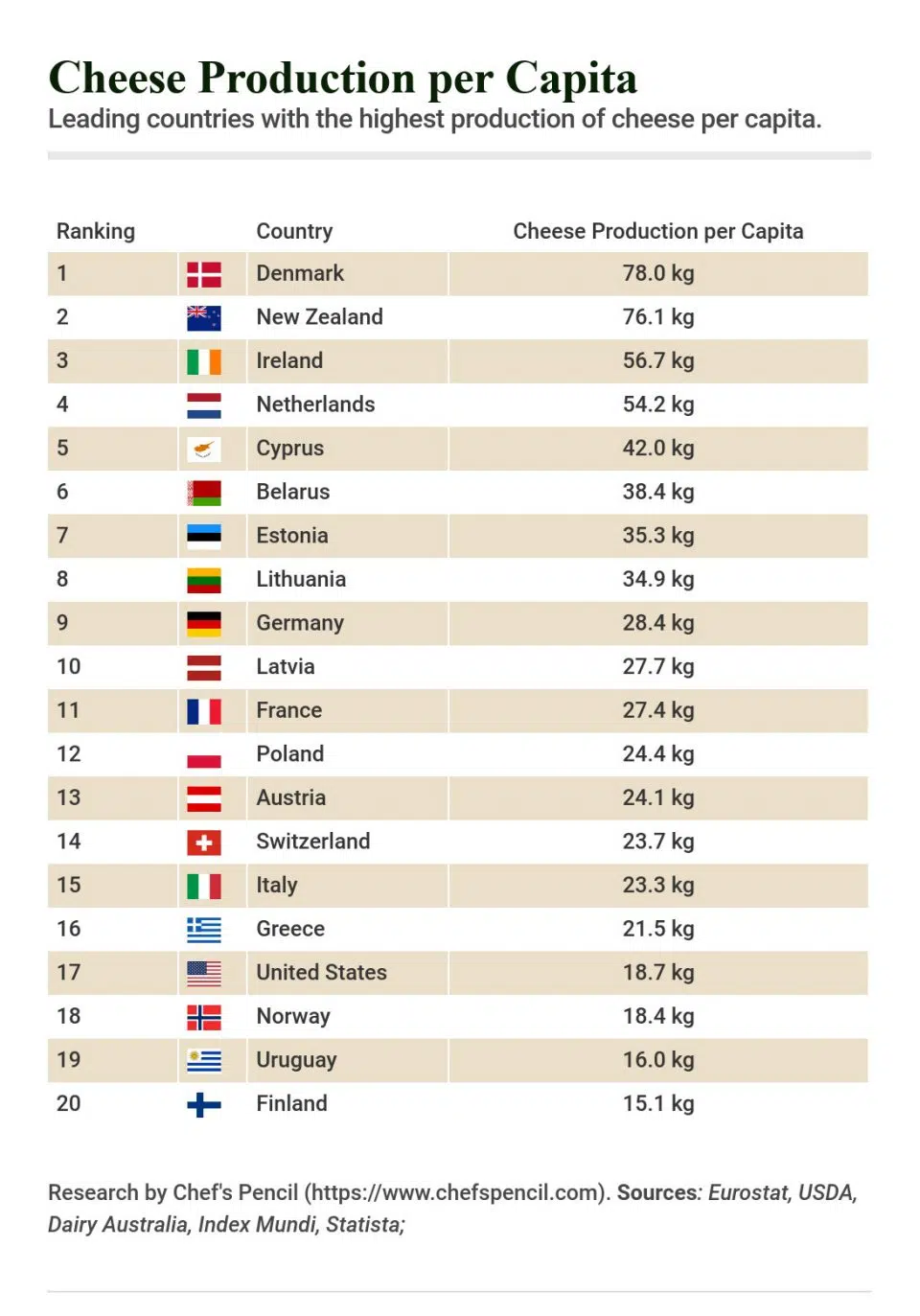
World’s Top Cheese-producing Countries per Capita


source.

What country immediately comes to mind when you think of cheese? Is it France or perhaps Italy, given that they use enormous quantities of cheese for all that delicious pasta and pizza? Or is it the Netherlands? What about the United States? 

The United States is the world’s largest producer of cheese, followed by Germany, France, and Italy. But when it comes to the highest cheese production per capita, do these four nations still top the charts?

We did the research and the math to see what comes up. You might be surprised by some of the results. 

And because the US is in a league of its own when it comes to cheese production, we thought we’d also look at US states as if they were separate countries, and ran the numbers again, with surprising results. Keep reading to learn about all of these findings, and more! 

Denmark, New Zealand, and Ireland are the world’s top cheese producers per capita 

We first looked at each country’s total yearly cheese production and correlated that with the size of each country’s population to see how much cheese is produced per person. With just a couple of exceptions, the cheese production volumes are for the year of 2021.

Monday, 25 July 2022

Effect of Cheese Intake on Cardiovascular Diseases and Cardiovascular Biomarkers


the full paper is here.


Background: A growing number of cohort studies revealed an inverse association between cheese intake and cardiovascular diseases, yet the causal relationship is unclear. 


Objective: To assess the causal relationship between cheese intake, and cardiovascular diseases and cardiovascular biomarkers. Methods: A two-sample Mendelian randomization (MR) analysis based on publicly available genome-wide association studies was employed to infer the causal relationship. The effect estimates were calculated using the random-effects inverse-variance-weighted method. 


Results: Cheese intake per standard deviation increase causally reduced the risks of type 2 diabetes (odds ratio (OR) = 0.46; 95% confidence interval (CI), 0.34–0.63; p = 1.02 × 10⁻⁶), heart failure (OR = 0.62; 95% CI, 0.49–0.79; p = 0.0001), coronary heart disease (OR = 0.65; 95% CI, 0.53–0.79; p = 2.01 × 10⁻⁵), hypertension (OR = 0.67; 95% CI, 0.53–0.84; p = 0.001), and ischemic stroke (OR = 0.76; 95% CI, 0.63–0.91; p = 0.003). Suggestive evidence of an inverse association between cheese intake and peripheral artery disease was also observed. No associations were observed for atrial fibrillation, cardiac death, pulmonary embolism, or transient ischemic attack. The better prognosis associated with cheese intake may be explained by lower body mass index (BMI; effect estimate = −0.58; 95% CI, from −0.88 to −0.27; p = 0.0002), waist circumference (effect estimate = −0.49; 95% CI, from −0.76 to −0.23; p = 0.0003), triglycerides (effect estimate = −0.33; 95% CI, from −0.50 to −0.17; p = 4.91 × 10⁻⁵), and fasting glucose (effect estimate = −0.20; 95% CI, from −0.33 to −0.07; p = 0.0003). There was suggestive evidence of a positive association between cheese intake and high-density lipoprotein. No influences were observed for blood pressure or inflammation biomarkers. 


Conclusions: This two-sample MR analysis found causally inverse associations between cheese intake and type 2 diabetes, heart failure, coronary heart disease, hypertension, and ischemic stroke.

Friday, 5 March 2021

Why is there only one Irish cheese with protected status?

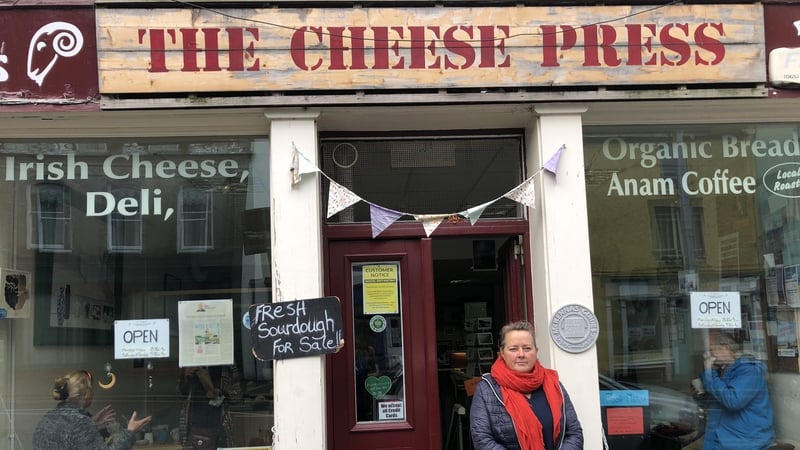
Chockablock with Irish cheeses: the Cheese Press in Ennistymon, Co Clare. Photo: Teresa Mannion


source: RTE Brainstorm


Opinion: the protected designation of origin scheme could be of huge commercial benefit to Irish cheese makers

Would it surprise you to learn that Ireland has only one protected designation of origin (PDO) cheese? By comparison with Ireland's only PDO cheese (the Imokilly Regato), Greece has 23 PDO cheeses. 

First of all, what's a PDO and why is it so important? PDO refers to a number of European Union schemes which promote and protect names of quality agricultural products and foodstuffs. Aside from the PDO scheme, there's also schemes for protected geographical indication and traditional specialities guaranteed.

All of these schemes aim to protect the reputation of the regional foods, promote rural and agricultural activity, help producers obtain a premium price for their authentic products and eliminate unfair competition and misleading of consumers by non-genuine products, which may be of inferior quality or of different flavour.

From RTÉ Radio 1's Countrywide, a discussion on the Protected Designation of Origin scheme for food

Products registered under these schemes may be marked with a special logo to help identify those products. The schemes are based on the legal framework provided by the EU Regulation No 1151/2012 of the European Parliament on quality schemes for agricultural products and foodstuffs.

The laws basically protect the names of wines, cheeses, hams, sausages, seafood, olives, olive oils, beers, balsamic vinegar, regional breads, fruits, raw meats and vegetables. Examples of PDO labelled foods are the Italian Gorgonzola and Parmigiano-Reggiano, the Greek feta and the French roquefort. 

So how does PDO status protect local producers? Take, for example, the Roquefort cheese. This blue cheese must be made from milk of a certain breed of sheep and matured in the natural caves near the town of Roquefort-sur-Soulzon in the Aveyron region of France, where it is colonised by the fungus Penicillium roqueforti that grows in these caves.

From Ile de France Cheese, the strict rules which define what can be called Roquefort cheese 

The system is similar to appellation systems used throughout Europe, such as the appellation d'origine contrôlée in France, the denominazione di origine controllata in Italy, the denominação de origem controlada in Portugal, the denumire de origine controlată system in Romania and the denominación de origen in Spain.

The cheese industry in Ireland has many unique characteristics. On one hand, we have the major players, big dairy companies that make mostly cheddar from cow's milk. Then, we have tens of small family business who make amazing cheeses in sensory terms. A PDO labelling would help these producers in promoting their cheeses nationally but also (and mainly) internationally.

My research team studies the cardioprotective properties of sheep and goat cheeses. These cheeses have strong bioactivities against platelet aggregation and the onset of atherosclerosis. We have screened a number of ovine (sheep) and caprine (goat) cheeses and all these cheeses have strong anti-thrombotic and anti-inflammatory properties.

From RTÉ Radio 1's Today show, chef Domini Kemp and food writer Catherine Cleary's guide to Irish cheese

Due to the Covid-19 pandemic, the hospitality sector has closed and small cheese companies have lost a huge part of their trade. Consumers now buy from home via online sales so small cheese businesses rely on having a good website and online strategy to boost their online sales. But they also need to differentiate themselves from other cheese players. The PDO labelling is a strong way to provide an unique selling point for these family businesses and the Government needs to help them to obtain such pedigree.

So why haven't Irish cheese producers sought PDO status for their products? Anecdotal evidence from cheese producers refers to the lengthy and laborious procedure to obtain PDO status. This must change. The Irish food board, Bord Bia, needs to create simpler procedures and support mechanisms for farmers who wish to apply for PDO status.

In today’s business environment where food exports to EU are so straightforward, the fact that Ireland has only one PDO cheese looks like we are shooting ourselves in the foot. Irish farmers produce unique cheeses with superb sensory properties that can easily compete on an European and international level, but PDO status is a must. The State needs to simplify the process and create dedicated teams of scientists to collaborate with farmers in order to boost PDO applications.


The views expressed here are those of the author and do not represent or reflect the views of RTÉ

Saturday, 13 February 2021

PDO cheeses, Italy, Greece and ...Ireland


I have been studying for the past two weeks, the types and numbers of cheeses in Italy, Greece and Ireland that carry a PDO brand-label (Protected Designation of Origin)

It's quite remarkable that Greece has about 23 cheeses with PDO, Italy has about 50 cheeses and Ireland, with many small family businesses making amazing cheeses using goat and sheep milk, has 0 (zero!) PDO cheeses!

I have asked some Irish friends who make such cheeses and the response I got from them is that in order to get a PDO labelling is a laborious procedure and the Irish State doesn't help them with this.

In 2021 and during a pandemic, when e-commerce is a vital tool for selling unique and niche dairy products, I am still surprised with the Irish approach: they produce world-class goat and sheep cheeses and still none of them has a PDO labelling.

Why is that?

Do the Irish, in contrast of the rest of the world, believe that PDO labelling can't assist exports and sales?

What does the Irish State and its agents (e.g. Bord Bia) think about that? If they think that PDO labelling does not promote sales, then why other cheese producing countries (like Greece and Italy) do so?

Saturday, 4 April 2020

Covid-19, NCDs and the role of yoghurt and cheese


Ronan Lordan and Ioannis Zabetakis (University of Limerick, Limerick, Ireland) write:


Since December 2019 and the beginning of 2020, the world is facing a mega crisis that has two dimensions: one health crisis against COVID-19 (coronavirus disease 2019) and a subsequent financial crisis with huge implications for employment, commerce, travel, and manufacture.
On 23rd March, the World Health Organisation (WHO) issued guidelines on the link between COVID-19 and non-communicable diseases (NCDs) (Fig 1).


Figure 1: The link between non-communicable diseases (NCDs) and COVID-19

 
One risk major risk factor for developing NCDs is obesity. Worryingly, almost two thirds of patients who fell seriously ill from the coronavirus were obese and nearly 40 per cent were under the age of 60, an NHS audit has revealed in Great Britain [1]. This data viewed in tandem with the WHO guidelines as shown above highlights the fact that people with NCDs have a weaker immune system. As obesity is a major risk factor for developing NCDs, obesity in itself might be a risk factor for developing severe illness for individuals who becomes infected with COVID-19.

However, it’s not all bad news. In light of the message that we need to take from these guidelines is a message that we have communicated in our previous articles: Our best defence against NCDs and the optimum way to maintain a strong immune system is through following a healthy lifestyle. We can maintain a healthy lifestyle by exercising and adhering to a healthy diet.

In the days of home isolation for many millions of people all around the world, exercise needs to take the form of jogging, cycling (if we can still cycle where we live), walking or anything that can be achieved given your circumstances. However, what can we do about our diet?

Diet is the key
Now, that, we spend most of our time at home, it’s a great opportunity to re-evaluate our diet and re-think how we can improve it. Our diet can certainly impact our health and our immune system. Therefore, it’s time to revisit the Mediterranean diet pyramid (Fig 2) to try enrich our diet with foods from the bottom three shelves, two of these foods are cheese and yoghurt.


Figure 2: The Mediterranean diet pyramid


Yoghurt: A food with strong anti-inflammatory activities
Yoghurt is a nutrient dense fermented dairy product with many health benefits.
During milk’s fermentation, a myriad of bioactive molecules that act against inflammation are formed, these molecules are called polar lipids [2,3]. In our research, we have assessed the anti-inflammatory properties of these polar lipids in sheep yoghurts and goat cheeses. We have found that they can reduce the aggregation of platelets and potentially decrease inflammation associated with NCDs [2,3]. 

Yoghurt is associated with a host of other benefits including lower levels of obesity in yoghurt consumers [4]. Yoghurt can also boost the immune system due to its probiotic capacity and its high vitamin content [5]. From a nutritional point of view, any yoghurt that is low in sugar will provide health benefits to the consumer. However, a sheep yoghurt (Fig 3) is an excellent source of protein, healthy polar lipids, low in sugar, and high in live probiotic cultures. Coupled with exercise and a healthy diet, yoghurt might help keep our immune systems in good health and give us something nutritious and tasty to look forward to.
On the other hand, cheese is an excellent source of nutrients (calcium, protein, vitamin A, vitamin K, phosphorus, niacin and thiamin, proteins and lipids, polar lipids included). They are a main part of the Med diet (Fig 2).  
The cardioprotective and anti-inflammatory properties of dairy products as part of a balanced diet are discussed extensively in our book [6].


Figure 3. A label of a sheep’s yogurt made in Ireland

Our diet and the local economies
Two final words: during this crisis, the small and family run businesses are going to suffer most. The impact that this financial crisis will have on the food chain is going to be huge. As consumers, we can do two things: first, we need to re-assess our diet and enrich it with foods with strong anti-inflammatory activities (e.g. yoghurt and we especially love sheep yoghurt). Secondly, we can support our local food producers by ordering their products on-line. By buying local food, we support our communities; this is vital during this crisis. For Ireland, an excellent list of local producers of quality foods and drinks is available [7].

References


Friday, 6 September 2019

From feta to American slices, a ranking of cheeses by healthfulness


Very exciting news! Our research got a mention in the Washington Post this week! Enjoy!

The full newspaper article is here.

Research is starting to suggest, however, that the issue may be more complex. One study published in 2018 showed dairy fats such as cheese had a neutral-to-positive effect on the heart. A 2018 review from Harvard researchers concluded there was a “null or weak inverse association between consumption of dairy products and risk of cardiovascular disease,” though it said more research was needed. A study from the Lancet medical journal found dairy products such as cheese were linked to a lower mortality risk.

Monday, 26 August 2019

new paper from our group: Caprine milk fermentation enhances the antithrombotic properties of cheese polar lipids


Caprine milk fermentation enhances the antithrombotic properties of cheese polar lipids

Abstract

The effect of fermentation on the antithrombotic properties of polar lipids in raw and pasteurised caprine milk was assessed through the production of various cheeses using the same starter culture. The total lipids (TL), total neutral lipids (TNL), and total polar lipids (TPL) were extracted from each milk and cheese and the TPL fatty acid profiles were analysed by GC–MS. It was determined that fermentation influenced the polar lipid fatty acid composition. The milk and cheese polar lipids exhibited potent antithrombotic activities with IC50 values ranging from 79 to 226 µg against platelet-activating factor (PAF) induced platelet aggregation. Finally, shotgun metagenomics determined the species-level microbial composition and functional potential of each milk and cheese. Several microbe-encoded phospholipid biosynthetic genes were identified in the most antithrombotic cheeses. Lactococcus lactis and other microbial species may play a significant role in determining the antithrombotic properties and fatty acid composition of caprine cheese polar lipids. 

© 2019 Elsevier Ltd


= = =

the full paper is here

Saturday, 10 November 2018

Fermented dairy products could protect against heart attacks


Men who eat plenty of fermented dairy products have a smaller risk of incident coronary heart disease than men who eat less of these products, according to a new study from the University of Eastern Finland. A very high consumption of non-fermented dairy products, on the other hand, was associated with an increased risk of incident coronary heart disease.

Earlier studies have shown that... (the full story is here).

= = = = = = =

our view: We fully agree that fermented dairy are rich in anti-inflammatory compounds. It is not surprising that in the Med diet pyramid, cheese and yogurt occupy a lower shelf, i.e. they need to be consumed on a daily basis.
 

Tuesday, 20 February 2018

Dairy consumption and inflammatory profile: A cross-sectional population-based study, São Paulo, Brazil

Dairy consumption and inflammatory profile: A cross-sectional population-based study, São Paulo, Brazil

Methods

Data were acquired from the Health Survey for São Paulo, a cross-sectional population-based study. All individuals 20 to 59 y of age with complete food consumption information (24-h dietary recall and food frequency questionnaire) and blood sample analysis were included (N = 259). The sample was separated into two groups according to systemic inflammatory pattern considering plasma levels of C-reactive protein; tumor necrosis factor-α; soluble intracellular adhesion molecule; soluble vascular cell adhesion molecule, monocyte chemoattractant protein; interleukin-1β, -6, -8, -10, and -12; adiponectin; leptin; and homocysteine. Multiple logistic regression tests were conducted to estimate the odds ratio for the inflammatory cluster across tertiles of dairy consumption.

Results

When adjusted by age, smoking status, and energy intake the odds ratio for the inflammatory cluster group in the highest tertile of yogurt consumption was 0.34 (95% confidence interval [CI], 0.14–0.81) relative to the reference tertile, demonstrating also a linear effect (Ptrend = 0.015). Cheese consumption exhibited an odds ratio of 2.49 (95% CI, 1.09–5.75) relative to the reference.

Conclusions

Increasing yogurt consumption might have a protective effect on inflammation, whereas cheese consumption appears to be associated with a proinflammatory status. The results of the present study aggregate a new perspective on existing evidence demonstrating the importance of assessing the contribution of dairy products on diet and their effect on the development of non-communicable diseases and associated risk factors.

Tuesday, 22 August 2017

for the Love of Cheese

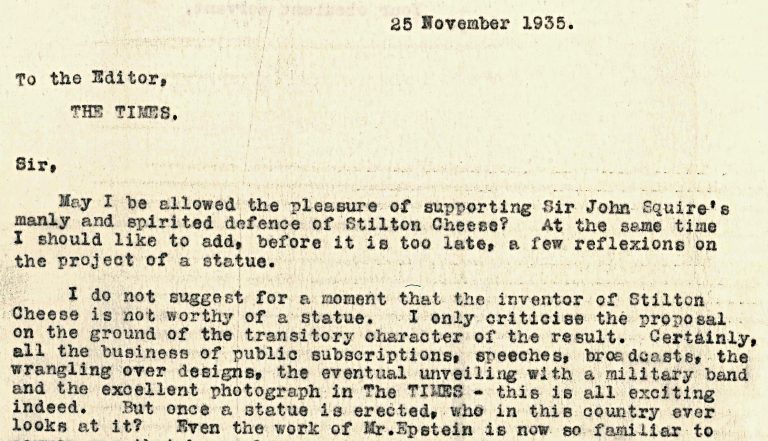
Carbon copy of T. S. Eliot’s original letter to the Times


Included in the latest volume of the Letters of T. S. Eliot is a letter to the Editor of the Times entitled ‘Stilton Cheese’, written on 25 November 1935 and published a few days later. Eliot is replying to a letter from poet and literary editor J. C. Squire and his ‘spirited defence of Stilton Cheese’. An expert on the cheese, Squire was heading up the Stilton Memorial Committee and had proposed the erection of a statue of the inventor of the Stilton – a Mrs Paulet of Wymondham. While Eliot could see the worthiness of a statue, he questioned whether anyone would bother to look at i...


[continue reading here]