Showing posts with label MDPI. Show all posts

Tuesday, 2 January 2024

Gastronomic Curiosity and Consumer Behavior: The Impact of Television Culinary Programs on Choices of Food Services

 a must read paper, on foods mdpi.

Abstract
In highly developed countries, more and more people use culinary services. Cooking at home, for the family, is giving way to culinary services. Consumers either order food home or use the offers of restaurants and bars. Consumers’ choice of culinary form may be influenced by cooking television programs. Many TV stations broadcast cooking programs. This study examined the impact of television culinary programs on consumer behavior in the restaurant services market. The article examines the interplay of emotional responses, personality traits, and culinary preferences to understand how TV cooking programs influence dining decisions. The study was conducted using the CAWI method, which involved 742 respondents. The study, conducted between May 2021 and April 2022, was addressed to people who visited restaurants presented in the Polish culinary TV show titled “Kitchen Revolutions”. The study revealed that almost 3/4 of the respondents chose restaurants based on the program’s recommendations. Although there was a strong emotional connection with this program—nearly half of the respondents expressed delight in the taste of snacks and main courses—this did not always translate into an increased frequency of eating meals away from home. Only every third respondent said that the program influenced their gastronomic behavior. The research hypotheses examined the extent to which culinary TV shows influence the frequency of visits to restaurants, the perceived quality of life, and the influence on consumers with specific personality traits. The results partially supported the hypothesis that cooking programs on television encourage people to eat out more often, but the perceived impact on quality of life and on some personality traits was less clear. The article contributes to the understanding of consumer behavior in the food service market by highlighting the complex dynamics of emotional reactions, personality traits, and the impact of culinary television programs. The findings have practical implications for the restaurant industry, suggesting a focus on emotional impact, food quality and presentation, and targeting marketing strategies towards consumers who are open to new experiences and ready to experiment.


Friday, 19 June 2020

Special Issue "From Farm to Fork: Balancing the Needs for Sustainable Food Production and Food for Health Promotion"

Special Issue "From Farm to Fork: Balancing the Needs for Sustainable Food Production and Food for Health Promotion"

A special issue of Sustainability (ISSN 2071-1050). This special issue belongs to the section "Sustainable Food".

Deadline for manuscript submissions: 15 March 2021.

 = = = = = = = = = = = = =


Dear Colleagues,

The current and future sustainability of humanity is intrinsically linked to the environmental and biophysical conditions on our planet. There is a widespread belief that these conditions are greatly compromised by anthropogenic activity and that, unless action is taken, irreversible change will be unavoidable. Alongside these challenges is a growing human population and the need for sufficient and nutritional food. Although recent international initiatives such as the 2030 Agenda for Sustainable Development and associated 17 Sustainable Development Goals recognize these challenges significant information gaps remain. In particular, there is an ever-growing need to balance the interdependencies and conflicts between economic, social and environmental systems so that sustainability across local and global scales and overall food security can be realized.

This special issue will address these issues and seeks contributions from colleagues interested in sustainable food production from economic, social and environmental perspectives as well as health promotion. Contributions which address synergies and conflicts between these issues are especially welcome. This special issue aims to publish high quality research papers and reviews that will be of interest to scientists, policy makers, educators and stakeholders across the full spectrum of farm to fork for sustainable food production and health promotion.

Kind Regards,

Dr. Ken Byrne

Dr. Ioannis Zabetakis
 
Guest Editors

= = = = = = = = = = = = = = =

Dr. Ken Byrne 
 
 
Leading Guest Editor
 
Department of Biological Sciences, University of Limerick, Limerick V94 T9PX, Ireland
 
Interests: the impact of land use; land use change on soil carbon stocks and greenhouse gas emissions; carbon storage in harvested wood products; forest ecosystem services; nutrient stores in forest biomass

= = = = = = = = 

Dr. Ioannis Zabetakis  
 
Assistant Guest Editor
Department of Biological Science, University of Limerick, Ireland.
 
Interests: Food Security; Functional Foods and Inflammation; Heavy metals in the Food Chain

Wednesday, 20 May 2020

new paper from our team: "COVID-19: The Inflammation Link and the Role of Nutrition in Potential Mitigation "

COVID-19: The Inflammation Link and the Role of Nutrition in Potential Mitigation 

 
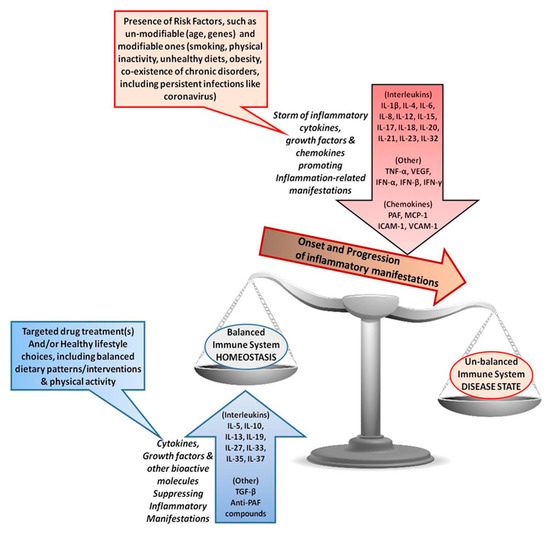
A reepresentation of the inflammatory molecules involved in infection and how certain dietary components may interact with them. Included are the cytokines, growth factors, and other chemokines that promote the onset and progression of inflammatory manifestations, dysregulation of the immune system, and a diseased state due to the effects of several unmodifiable and modifiable risk factors. Targeted drug treatments and/or healthy lifestyle choices such as balanced diets and physical activity can counterbalance such inflammatory manifestations towards homeostasis.
 
 
1
Department of Biological Sciences, University of Limerick, Limerick V94 T9PX, Ireland
2
Health Research Institute, University of Limerick, Limerick V94 T9PX, Ireland
3
Institute for Translational Medicine and Therapeutics, Perelman School of Medicine, University of Pennsylvania, Philadelphia, PA 19104-5158, USA
4
Department of Physical Education and Sport Sciences, University of Limerick, Limerick V94 T9PX, Ireland
Received: 22 April 2020 / Revised: 11 May 2020 / Accepted: 17 May 2020 / Published: 19 May 2020
 

Abstract

The novel coronavirus disease (COVID-19) pandemic caused by severe acute respiratory syndrome coronavirus 2 (SARS-CoV-2) has engulfed the world, affecting more than 180 countries. As a result, there has been considerable economic distress globally and a significant loss of life. Sadly, the vulnerable and immunocompromised in our societies seem to be more susceptible to severe COVID-19 complications. 
Global public health bodies and governments have ignited strategies and issued advisories on various handwashing and hygiene guidelines, social distancing strategies, and, in the most extreme cases, some countries have adopted “stay in place” or lockdown protocols to prevent COVID-19 spread. Notably, there are several significant risk factors for severe COVID-19 infection. 
These include the presence of poor nutritional status and pre-existing noncommunicable diseases (NCDs) such as diabetes mellitus, chronic lung diseases, cardiovascular diseases (CVD), obesity, and various other diseases that render the patient immunocompromised. 
These diseases are characterized by systemic inflammation, which may be a common feature of these NCDs, affecting patient outcomes against COVID-19. 
In this review, we discuss some of the anti-inflammatory therapies that are currently under investigation intended to dampen the cytokine storm of severe COVID-19 infections. Furthermore, nutritional status and the role of diet and lifestyle is considered, as it is known to affect patient outcomes in other severe infections and may play a role in COVID-19 infection. 
This review speculates the importance of nutrition as a mitigation strategy to support immune function amid the COVID-19 pandemic, identifying food groups and key nutrients of importance that may affect the outcomes of respiratory infections.


The background story of this paper is here. 


Wednesday, 21 August 2019

An award for one of our papers!


Inflammation, not Cholesterol, Is a Cause of Chronic Disease

Authors: Alexandros Tsoupras, Ronan Lordan and Ioannis Zabetakis


Award: The value of the Award is 700 Swiss Francs and one free publication quota

= = =


Full information on these awards is available here.

Friday, 30 November 2018

10k downloads


We finally have reached the 10,000 dowload point, thanks all for sharing
our work which you can find here.


Alexandros, Ronan and Ioannis
 

Thursday, 5 April 2018

Fish and Inflammation

  (my latest article in Aquafeed) (March 2018)
 
 
by Ioannis Zabetakis

We are what we eat. Our food is also what it eats.
  

In other words, if fish are fed better aquafeeds, then we can improve the nutritional value of the final fish product, maximise the added value of the final produce and expand nutraceutical and pharmaceutical applications of fish, fish products and marine oils.

Working towards the improvement of the nutritional value of aquafeeds and fish, we would need to focus on the bioactivities of fish components against inflammation.

Fish have a great positive impact on all chronic diseases, including cardiovascular diseases (CVDs). Linking fish consumption to CVDs was first established through the seven-country study and today we know that fish components have strong cardioprotective and anti-inflammatory properties.

The Journal Fishes published by MDPI is going to publish a special issue titled“Fish and Inflammation”.
In this Special Issue, we would like to present the latest research on fish consumption and its impact on inflammation-related chronic diseases in humans, e.g., CVDs. In vitro and ex vivo studies are equally welcome.

We would be pleased to solicit manuscripts pertaining to original research, mini and full reviews, short communications, as well as perspectives, which address any aspect of fish, CVDs and inflammation.

Submissions are invited that include, but are not limited to: Fish diet and its impact on the nutritional value of fish; Fish intake and development of CVDs; Specific fish components (e.g., polar lipids, omega-3 fatty acids) and their anti-inflammatory properties; Bioactive compounds from the seafood chain.


Read the full article, HERE.