Inflammation and cardiovascular disease: are marine phospholipids the answer?
Ronan
Lordan,  *abc
Shane
Redfern,a
Alexandros
Tsoupras
ab
and
Ioannis
Zabetakis
ab
*abc
Shane
Redfern,a
Alexandros
Tsoupras
ab
and
Ioannis
Zabetakis
ab
*
Corresponding authors
a
Department of Biological Sciences, University of Limerick, Limerick, Ireland
E-mail: Ronan.Lordan@ul.ie
E-mail: Ronan.Lordan@ul.ie
b
Health Research Institute (HRI), University of Limerick, Limerick, Ireland
c
Institute for Translational Medicine and
Therapeutics, Perelman School of Medicine, University of Pennsylvania,
Philadelphia, PA 19104-5158, USA
Abstract
Since the
discovery that Greenlandic Innuits had a lower risk of developing
cardiovascular diseases (CVD) due to their diet of fish and as a
consequence high polyunsaturated fatty acids (PUFA) intake, scientific
interest in the therapeutic value of n-3 PUFA such as eicosapentaenoic
acid (EPA) and docosahexaenoic acid (DHA) has grown.
It is well-accepted that fish consumption is associated with the prevention of inflammation and CVD. As a result, fish oil supplements and nutraceuticals are widely consumed.
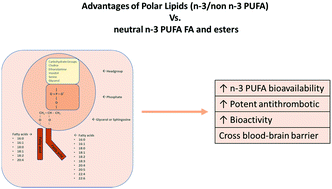
Conversely, recent meta-analyses have cast doubt over the benefits n-3 PUFA due to heterogenous outcomes of numerous randomized controlled trials. However, the majority of clinical studies conducted have used n-3 PUFA supplements in their neutral forms as free fatty acids or bound to triacylglycerides (TAG) or ethyl esters. Current research indicates that n-3 PUFA bound to polar lipids (PL) such as phospholipids seem to exert differential bioavailability and biological effects upon consumption in contrast to neutral forms of n-3 PUFA.
In this review, we discuss the promising health benefits of marine PL rich in n-3 PUFA that seem to go beyond those of neutral n-3 PUFA. However, further intensive research is required to discern the full extent of the biological activities of marine n-3 PL and their potential use in functional foods and nutraceuticals.

No comments:
Post a Comment