Here is a personal story: Sept 2015, I was invited for a job interview at UL, for the 6th October 2015. As I was getting ready for this interview, I was trying to do my homework as best as I could. I really wanted that job and take my family away from Greece...
UL's interview would be my 5th one...and I wanted to perform as bestest as I could... (you know the feeling if Greece is sinking, and the future for my boys would be bleak...)
As I was doing my HW, I started reading about the Plassey house where an excellent restaurant exists.
And...oh My God! I found this about the name Plassey.
Robert Clive, 1st Baron Clive, KB, FRS (29 September 1725 – 22 November 1774), also known as Clive of India,[1][2][3] was the first British Governor of the Bengal Presidency. Clive has been widely credited for laying the foundation of the British East India Company (EIC) rule in Bengal.[4][5][6][7][8][9] He began as a writer (the term used then in India for an office clerk) for the EIC in 1744 and established Company rule in Bengal by winning the Battle of Plassey in 1757.[10] In return for supporting the Nawab Mir Jafar as ruler of Bengal, Clive was granted a jagir of £30,000 (equivalent to £4,300,000 in 2021) per year which was the rent the EIC would otherwise pay to the Nawab for their tax-farming concession. When Clive left India in January 1767 he had a fortune of £180,000 (equivalent to £25,700,000 in 2021) which he remitted through the Dutch East India Company.[11][12]

Clive's solitary reflection before the Battle of Plassey
Aftermath[edit]
In the evening of 23 June, Clive received a letter from Mir Jafar asking for a meeting with him. Clive replied that he would meet Mir Jafar at Daudpur the next morning. When Mir Jafar arrived at the British camp at Daudpur in the morning, Clive embraced him and saluted him as the Nawab of Bengal, Bihar and Odisha. He then advised Mir Jafar to hasten to Murshidabad to prevent Siraj's escape and the plunder of his treasure. Mir Jafar reached Murshidabad with his troops on the evening of 24 June. Clive arrived at Murshidabad on 29 June with a guard of 200 European soldiers and 300 sepoys in the wake of rumours of a possible attempt on his life. Clive was taken to the Nawab's palace, where he was received by Mir Jafar and his officers. Clive placed Mir Jafar on the throne and acknowledging his position as Nawab, presented him with a plate of gold rupees.[115][116]
Siraj-ud-daulah had reached Murshidabad at midnight on 23 June. He summoned a council where some advised him to surrender to the British, some to continue the war and some to prolong his flight. At 22:00 on 24 June, Siraj disguised himself and escaped northwards on a boat with his wife and valuable jewels. His intention was to escape to Patna with aid from Jean Law. At midnight on 24 June, Mir Jafar sent several parties in pursuit of Siraj. On 2 July, Siraj reached Rajmahal and took shelter in a deserted garden but was soon discovered and betrayed to the local military governor, the brother of Mir Jafar, by a man who was previously arrested and punished by Siraj. His fate could not be decided by a council headed by Mir Jafar and was handed over to Mir Jafar's son, Miran, who had Siraj murdered that night. His remains were paraded on the streets of Murshidabad the next morning and were buried at the tomb of Alivardi Khan.[117][118][119]
According to the treaty drawn between the British and Mir Jafar, the British acquired all the land within the Maratha Ditch and 600 yards (550 m) beyond it and the zamindari of all the land between Calcutta and the sea. Besides confirming the firman of 1717, the treaty also required the restitution, including donations to the navy squadron, army and committee, of 22,000,000 rupees (£2,750,000) to the British for their losses. However, since the wealth of Siraj-ud-daulah proved to be far less than expected, a council held with the Seths and Rai Durlabh on 29 June decided that one half of the amount was to be paid immediately – two-thirds in coin and one third in jewels and other valuables. As the council ended, it was revealed to Omichund that he would receive nothing with regard to the treaty, hearing which he went insane.[120][121]
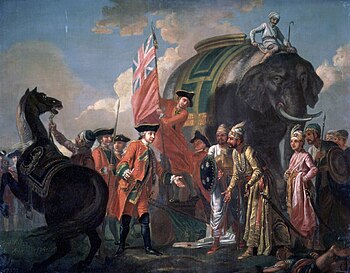
and here is the most interesting part of the whole story!
Return to Great Britain[edit]


In 1760, the 35-year-old Clive returned to Great Britain with a fortune of at least £300,000 (equivalent to £48,300,000 in 2021) and the quit-rent of £27,000 (equivalent to £4,300,000 in 2021) a year. He financially supported his parents and sisters, while also providing Major Lawrence, the commanding officer who had early encouraged his military genius, with a stipend of £500 (equivalent to £100,000 in 2021) a year. In the five years of his conquests and administration in Bengal, the young man had crowded together a succession of exploits that led Lord Macaulay, in what that historian termed his "flashy" essay on the subject, to compare him to Napoleon Bonaparte, declaring that "[Clive] gave peace, security, prosperity and such liberty as the case allowed of to millions of Indians, who had for centuries been the prey of oppression, while Napoleon's career of conquest was inspired only by personal ambition, and the absolutism he established vanished with his fall." Macaulay's ringing endorsement of Clive seems more controversial today, as some would argue that Clive's ambition and desire for personal gain set the tone for the administration of Bengal until the Permanent Settlement 30 years later. The immediate consequence of Clive's victory at Plassey was an increase in the revenue demand on Bengal by at least 20%, which led to considerable hardship for the rural population, particularly during the famine of 1770.[57]
During the three years that Clive remained in Great Britain, he sought a political position, chiefly that he might influence the course of events in India, which he had left full of promise. He had been well received at court, was elevated to the peerage as Baron Clive of Plassey, County Clare; had bought estates, and returned a few friends as well as himself to the House of Commons. Clive was MP for Shrewsbury from 1761 until his death. He was allowed to sit in the Commons because his peerage was Irish.[47] He was also elected Mayor of Shrewsbury for 1762–63.[58] The non-graduate Clive received an honorary degree as DCL from Oxford University in 1760, and in 1764 he was appointed Knight of the Order of the Bath.[59]
Clive set himself to reform the home system of the East India Company, and began a bitter dispute with the chairman of the Court of Directors, Laurence Sulivan, whom he defeated in the end. In this he was aided by the news of reverses in Bengal. Mir Jafar had finally rebelled over payments to British officials, and Clive's successor had put Qasim Ali Khan, Mir Jafar's son-in-law upon the musnud (throne). After a brief tenure, Mir Qasim had fled, ordering Walter Reinhardt Sombre (known to the Muslims as Sumru), a Swiss mercenary of his, to butcher the garrison of 150 British at Patna, and had disappeared under the protection of his brother, the Viceroy of Awadh. The whole company's service, civil and military, had become mired in corruption, demoralised by gifts and by the monopoly of inland and export trade, to such an extent that the Indians were pauperised, and the company was plundered of the revenues Clive had acquired. For this Clive himself must bear much responsibility, as he had set a very poor example during his tenure as Governor. Nevertheless, the Court of Proprietors, forced the Directors to hurry Lord Clive to Bengal with the double powers of Governor and Commander-in-Chief.[16]
Third journey to India[edit]

On 11 April 1765, Clive's ship docked at Madras. Upon learning of Mir Jafar's death and the aftermath of the Battle of Buxar, he sent a coded letter to a friend back in England, directing him to mortgage all his property and to buy as much of the Company's shares as possible, anticipating its rise.[60][61] On 3 May 1765 Clive landed at Calcutta to learn that Mir Jafar left him personally £70,000 (equivalent to £10,200,000 in 2021). Mir Jafar was succeeded by his son-in-law Kasim Ali, though not before the government had been further demoralised by taking £100,000 (equivalent to £14,500,000 in 2021) as a gift from the new Nawab; while Kasim Ali had induced not only the viceroy of Awadh, but the emperor of Delhi himself, to invade Bihar. At this point a mutiny in the Bengal army occurred, which was a grim precursor of the Indian rebellion of 1857, but on this occasion it was quickly suppressed by blowing the sepoy ringleader from a gun. Major Munro, "the Napier of those times", scattered the united armies on the hard-fought field of Buxar. The emperor, Shah Alam II, detached himself from the league, while the Awadh viceroy threw himself on the mercy of the British.[16]

Clive had now an opportunity of repeating in Hindustan, or Upper India, what he had accomplished in Bengal. He might have secured what is now called Uttar Pradesh, and have rendered unnecessary the campaigns of Wellesley and Lake. But he believed he had other work in the exploitation of the revenues and resources of rich Bengal itself, making it a base from which British India would afterwards steadily grow. Hence he returned to the Awadh viceroy all his territory save the provinces of Allahabad and Kora, which he presented to the weak emperor.[16]
Mughal Firman[edit]
In return for the Awadhian provinces Clive secured from the emperor one of the most important documents in British history in India, effectively granting title of Bengal to Clive. It appears in the records as "firman from the King Shah Aalum, granting the diwani rights of Bengal, Bihar and Odisha to the Company 1765." The date was 12 August 1765, the place Benares, the throne an English dining-table covered with embroidered cloth and surmounted by a chair in Clive's tent. It is all pictured by a Muslim contemporary, who indignantly exclaims that so great a "transaction was done and finished in less time than would have been taken up in the sale of a jackass". By this deed the company became the real sovereign rulers of thirty million people, yielding a revenue of £4,000,000 sterling (equivalent to £580,000,000 in 2021).[16]
On the same date Clive obtained not only an imperial charter for the company's possessions in the Carnatic, completing the work he began at Arcot, but a third firman for the highest of all the lieutenancies of the empire, that of the Deccan itself. This fact is mentioned in a letter from the secret committee of the court of directors to the Madras government, dated 27 April 1768. The British presence in India was still tiny compared to the number and strength of the princes and people of India, but also compared to the forces of their ambitious French, Dutch and Danish rivals. Clive had this in mind when he penned his last advice to the directors, as he finally left India in 1767:[16]
Attempts at administrative reform[edit]
Having thus founded the Empire of British India, Clive sought to put in place a strong administration. The salaries of civil servants were increased, the acceptance of gifts from Indians was forbidden, and Clive exacted covenants under which participation in the inland trade was stopped. Unfortunately this had very little impact in reducing corruption, which remained widespread until the days of Warren Hastings. Clive's military reforms were more effective. He put down a mutiny of the British officers, who chose to resent the veto against receiving presents and the reduction of batta (extra pay) at a time when two Maratha armies were marching on Bengal. His reorganisation of the army, on the lines of that which he had begun after Plassey, neglected during his absence in Great Britain, subsequently attracted the admiration of Indian officers. He divided the whole army into three brigades, making each a complete force, in itself equal to any single Indian army that could be brought against it.[62][63]
Clive was also instrumental in making the company virtual master of North India by introducing his policy of "Dual system of government". According to the new arrangement enforced by him, the company became liable only for revenue affairs of Bengal (Diwani) and Bihar while the administration and law and order was made a prerogative of the Nawab. An office of "Deputy Nawab" was created, who was at the helms of all the affairs vis a vis revenue of two of the richest provinces of India besides being the company's representative while the Nizamat (Law and order) remained in the hands of the Nawab who appointed his own representative to deal with the company. This system proved to be detrimental for the administration of Bengal and ultimately the "Dual system of government" was abolished by Clive.[64]
Retirement and death[edit]
Clive left India for the last time in February 1767. In 1768, he lived at the Chateau de Larzac in Pézenas, Hérault, Languedoc-Roussillon in southern France. Local tradition is that he introduced local bakers to a sweet pastry, Petit pâté de Pézenas, and that he (more obviously, his chef) had brought the recipe from India as a refined version of the savoury keema naan.[65] Pézenas is known for such delicacies.

Later in 1768, Clive was elected a Fellow of the Royal Society[59] and served as treasurer of the Royal Salop Infirmary in Shrewsbury.[66]
In 1769, he acquired the house and gardens of Claremont near Esher in Surrey, and commissioned Capability Brown to remodel the garden and house.
In 1772 Parliament opened an inquiry into the company's practices in India. Clive's political opponents turned these hearings into attacks on Clive. Questioned about some of the large sums of money he had received while in India, Clive pointed out that they were not contrary to accepted company practice, and defended his behaviour by stating "I stand astonished at my own moderation" given opportunities for greater gain. The hearings highlighted the need for reform of the company; a vote to censure Clive for his actions failed. Later in 1772, Clive was invested Knight of the Bath (eight years after he had been made knight bachelor),[59] and was appointed Lord Lieutenant of Shropshire.
A great famine between 1769 and 1773 reduced the population of Bengal by a third. It was argued that the activities and aggrandisement of company officials caused the famine, particularly abuse of trade monopoly and land tax used for the personal benefit of company officials.[67][68] These revelations and subsequent debates in Parliament reduced Clive's political popularity.[citation needed]
Clive continued to be involved in Parliamentary discussions on company reforms. In 1773, General John Burgoyne, one of Clive's most vocal critics, pressed the case that some of Clive's gains were made at the expense of the company and of the government. Clive again made a spirited defence of his actions, and closed his testimony by stating "Take my fortune, but save my honour." The vote that followed exonerated Clive, who was commended for the "great and meritorious service" he rendered to the country. Immediately thereafter Parliament began debating the Regulating Act of 1773, which significantly reformed the East India Company's practices.
On 22 November 1774 Clive died, aged 49, at his Berkeley Square home. His death was caused by a cut to his throat from a penknife he held. The manner of his death has long been the subject of controversy. No inquest was carried out, the absence of which caused contemporary newspapers to report his death as due to an apoplectic fit or stroke.[69][70] 20th-century biographer, John Watney, concluded: "He did not die from a self-inflicted wound ... He died as he severed his jugular with a blunt paper knife brought on by an overdose of drugs".[71] While Clive left no suicide note, Samuel Johnson wrote that he "had acquired his fortune by such crimes that his consciousness of them impelled him to cut his own throat".[72] Clive's demise has been linked to his history of depression and to opium addiction, but the likely immediate impetus was excruciating pain resulting from illness (he was known to suffer from gallstones) which he had been attempting to abate with opium[citation needed]. Shortly beforehand, he had been offered and declined command of British forces in North America.[73] He was buried in St Margaret's Parish Church at Moreton Say, near his birthplace in Shropshire.

Clive was awarded an Irish peerage in 1762, created Baron Clive of Plassey, County Clare; he bought lands in County Limerick and County Clare, Ireland, naming part of his lands near Limerick City, Plassey. Following Irish independence, these lands became state property. In the 1970s a technical college, later the University of Limerick, was built at Plassey.
= = = = = = =
P.S. why do we use this colonialist name at UL in the REPUBLIC of Ireland ? I rest my case._

No comments:
Post a Comment